Table of Contents
Breeding System for Endangered Insects

Author(s):
1. Cedric Florus
2. Jennifer Lattunen
3. Julius Knäuper
4. Krzysztof Jugiel
5. Marion Silva
6. Thomas Dekkers
Together with the coaches and the EPS Team.
Acknowledgement
Glossary
| Abbreviation | Description |
|---|---|
| EPS | European Project Semester |
| ISEP | Instituto Superior de Engenharia do Porto |
| USB | Universal Serial Bus |
| WBS | Work Breakdown Structure |
| IUCN | International Union for Conservation of Nature |
| IoT | Internet of Things |
| PBI | Product Backlog Item |
| BOM | Bill Of Materials |
| SWOT | Strengths, Weaknesses, Opportunities and Threats |
| PESTEL | Political, Economic, Social, Technological, Environmental and Legal |
| BBV2 | Beetle Breeder Version 2 |
| CBD | Convention on Biological Diversity |
| NbS | Nature based Solutions |
| STP | Segmentation, Targeting and Positioning |
| PDCA | Plan Do Check Act |
| CAD | Computer-aided Design |
| LCD | Liquid-crystal display |
| LED | Light Emitting Diode |
| LCA | Life Cycle Analysis |
| LVD | Low Voltage Directive |
| AWA | Animal Welfare Act |
| ESA | Endangered Species Act |
1. Introduction
Crafting a sustainable habitat for endangered insects demands creative problem-solving and versatility. This report showcases the collaborative efforts of a diverse team of students from various countries and academic areas participating in the European Project Semester (EPS) at the Instituto Superior de Engenharia do Porto (ISEP). EPS provides a platform for international students to address real-world challenges with a focus on ethics, sustainability, and market relevance. The insect breeding system, dubbed “Scarabreed” was developed by a team of six students during the spring of 2024. The primary goal was to develop a user-friendly system that enables the ethical and sustainable breeding of insects, thereby promoting the preservation of our essential ecosystem. Scarabreed aims to support conservation efforts by providing an adaptable shelter, for endangered insect species, designed for feeding, breeding, and studying insect behavior. This report outlines the research, design process, and testing of the initial prototype, emphasizing the value of collaborative and innovative solutions in preserving biodiversity.
1.1 Presentation
For the European Project Semester, six students from six different European countries, representing a range of academic backgrounds and cultural backgrounds, convened at ISEP. With classes and great teaching, this project offers the chance to broaden the student's knowledge and experiences for the future. The project was carried out exclusively in English. As none of the students have English as their first language, this project presents a valuable opportunity to improve their English language skills. Table 1 includes an introduction to each team member, including their city of home university, area of study, and a photo of the group in Figure 1 (see the image from left to right).
| Name | Studies | Location |
|---|---|---|
| Julius | Mechanical Engineering | Osnabrück, Germany |
| Thomas | Industrial Engineering Management | Den Bosch, the Netherlands |
| Jennifer | Civil and Construction Engineering | Vaasa, Finland |
| Marion | Packaging Engineering | Reims, France |
| Cedric | Product Development | Antwerp, Belgium |
| Krzysztof | Electronics and Telecommunication Engineering | Łódź, Poland |

1.2 Motivation
We came to Porto without specific expectations, yet with the intention of creating an innovative project. We all wanted a multidisciplinary project, involving design, mechanics and other fields beyond our usual expertise to explore. The semester offers a variety of classes, including management, marketing, and communication. Our main aim is to create a prototype of the project, to have something physical at the end of the semester. The second goal is for each team member to work on the project, offer their unique skills to it, engage completely in team activities, and show respect for the work of others. Each team member has written their individual motivation as seen in Table 2.
| Name | Motivation |
|---|---|
| Jennifer | My main reason for doing the EPS was to explore a new country and culture with other international students. Portugal has always been somewhere I've wanted to visit, so when I saw that Porto was a possible destination I immediately felt it was a golden opportunity for me. I have no doubt that this experience will be incredibly valuable for my future. It will help me improve my English, understand different cultures better, and work with people from diverse backgrounds and fields of study. I also think this journey abroad will be a great way to get to know myself better. |
| Marion | Porto was my first choice because of my origins, I wanted to discover my grand-parents country and cities. I also joined the EPS program in ISEP in Porto to explore new horizons through travel, forge lasting friendships, and immerse myself in different cultures. Embracing collaborative work in a group offers me a chance to explore new fields and enhance my engineering knowledge. This semester is for me a personal and professional growth. |
| Cedric | The reason I applied for a place in the EPS program at ISEP, is because I believe that expanding my horizon and experiencing different cultures through an educational approach will make me grow as a person intellectually and emotionally. Furthermore, I am convinced that input from people with different backgrounds and from different cultures could contribute significantly to my personal growth and will increase my creative capabilities and solution-oriented thinking. However, the main reason for me to apply to the EPS program in Porto over other EPS programs was the fact that this one takes place in an engineering faculty and is more academically oriented and less artistically oriented. I consider international experiences to be an advantage to develop myself as a person and I understand all too well the importance of cross-cultural relationships in the future. Environments like the EPS program take a person out of their comfort zone, which causes wonderful unexpected designs and experiences. |
| Julius | At school, we had the choice between a typical Erasmus mobility experience and an EPS project. When I weighed up my options, I decided in favour of the EPS project. The main reason for my decision was the exciting prospect of working with international students from different backgrounds. I'm also here to improve my English language skills, which is why I find projects like this particularly appealing. I chose Porto because it is so close to the sea and the nature in Portugal is so picturesque. |
| Thomas | I chose to participate in the EPS programme to gain unforgettable experiences abroad. My goal is to interact with people from different backgrounds and learn from their different cultures. In addition, I see this as an opportunity to get to know and understand myself better, become independent and adapt in a new environment. I believe this experience will not only benefit me academically, but also help me grow personally. |
| Krzysztof | I have chosen the EPS programme to gain experience. I wanted to go to Portugal to connect with another culture and meet new people. My goal during this semester is to expand my horizons in every possible way, that includes the knowledge of working efficiently in a team. I believe EPS will help me become better at working with people from all over the world, which will nurture my future career. |
1.3 Problem
The alarming decline of beetles, the most abundant species in the animal kingdom, poses a major threat to global biodiversity and ecosystem stability. Although beetles account for about 28% of all animal species with some 350,000 species and represent 40% of the insect population [David Britton, 2022], they are facing rapid population decline. Several factors contribute to this problem.
- Habitat Loss and Fragmentation: deforestation, urbanization, and unsustainable agricultural practices are causing the destruction and fragmentation of natural habitats, which are essential for the survival and reproduction of beetles [James Martin, 2018].
- Use of pesticides: Since 1990 the use of pesticides globally has grown with 80%. This contaminates the environment disrupting the balance of ecosystems upon which beetles rely [Arthur Neslen, 2022].
- Climate Change: increasing temperatures, unpredictable weather patterns, and extreme weather events are disturbing the life cycles of beetles, affecting their ability to find food, reproduce, and ultimately survive [Tara Lohan, 2023].
Due to these factors, there is a chance that 40% of all insects could go extinct in the next couple of decades [Tara Lohan, 2023].
1.4 Objectives
The aim of this project is to make ecosystems stronger by increasing biodiversity. This will be done by developing an insect breeder specified to breed beetles. With this insect breeder, team 4 aims to make it easier for consumers to do their bit to rebuild nature. A further aim of this project is to create more awareness about the importance of insects and in particular beetles.
1.5 Requirements
1. The Scarabreed Vivarium must comply with EU directives concerning the conservation and protection of endangered beetle species, including:
- Directive 92/43/EEC on the conservation of natural habitats and of wild fauna and flora [Conseil de l’Union Européenne, 1992].
2. Budget Requirements: 100 €
- Including materials and tests
- Maintain quality and functionality.
3. Product Requirements:
- Design a user-friendly interface for setting and controlling the vivarium’s conditions like temperature, humidity, lighting, and ventilation.
- Select appropriate hardware.
- Ensure the product meets all relevant safety and regulatory standards.
- Perform Finite Element Analysis (FEA) to simulate and validate structural integrity.
4. Environment and sustainable Requirement:
- Breed endangered beetle species to fight against their extinction.
- Design for energy efficiency to minimize power consumption.
- Use environmentally friendly materials in construction.
- Longevity: Ensure durability to withstand prolonged use with minimal need for replacement or repair.
- Recyclability: Use recyclable materials
- Reduce waste
5. Marketing requirements:
- Develop a marketing strategy to promote the brand and the product’s features and benefits (leaflet, poster, flyer, reusable packaging…)
- Highlight key aspects such as modularity, technological integration, and eco-responsibility.
1.6 Functional Tests
The main objective of the project is to build a prototype that is safe for insects to live and reproduce in, and that meets the specified requirements. By doing functional tests on the prototype, the team ensures that this idealization is done in the best possible way. The testing will be done on non-endangered beetles. Team Scarabreed received a plastic box with beetles from the ISEP teachers on 07/03/2024 including their necessary life essentials, as a first test to get an idea and see first-hand the different life stages of beetles. The team will test the usability for reproducing and preserving beetles and the electrical functions of the product prototype. The tests are listed below and will be described further in the project development chapter of this report.
- Software test: Test if we can put the electrical components in by first making a simulation.
- Electrical test: Test the electrical functions of the system.
- Digital design prototype test: Test the design of the product to evaluate if it fulfils all the mandatory directives.
- Real quality prototype test: Test if the product fulfils the quality directives.
- Full test: Test if the beetles can live during their different life-stages and reproduce in the vivarium.
- Safety test: Test if the product satisfies the safety regulations.
With these tests, the team will confirm if the product prototype can be produced as a real product, fulfilling all the directives and standards defined by the different organizations around the world. The most important test is the electrical as it will indicate if our product is practical to be safely and efficiently used by future users.
1.7 Project Planning
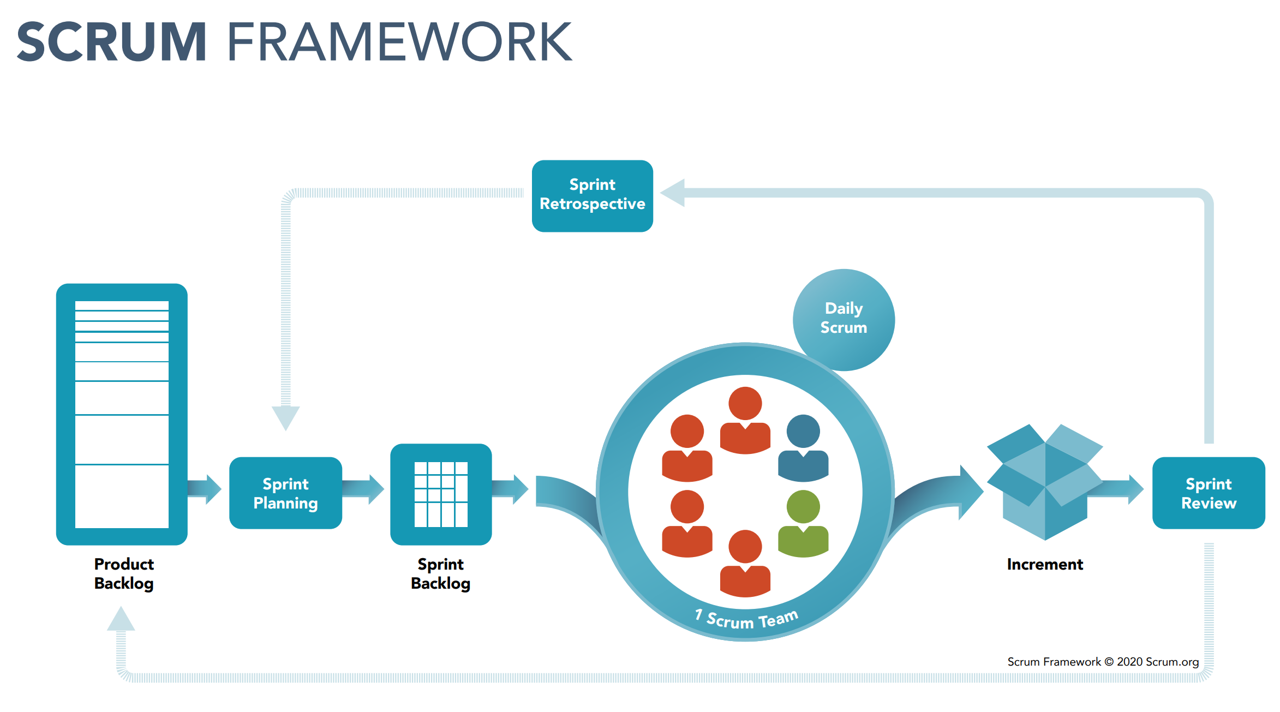
Project planning is a crucial step for the success of any project. It sets the framework, defines goals and milestones, and determines the approach to achieving these goals. In today's business world, agile methods such as Scrum have proven to be extremely effective. They are so effective because you can react quickly to changes and planning is very flexible. The JIRA tools is not only to optimise the project planning, but also to integrate agile practices such as Product Backlog, Sprint Planning, User Story Creation and Task Assignment, see Figure 2. In this context, the efficient use of JIRA plays a central role as it allows teams to plan, manage and track their projects while keeping track of overall progress. In the Project Management chapter, we go into more detail about different techniques and show how we organise ourselves.
1.8 Report Structure
Down below in Table 3 is the structure of the report. Here is a brief introduction of what the chapter is about.
| Number | Task | Description |
|---|---|---|
| 1 | Introduction | The team is being introduced and the project is defined with a problem statement and objectives |
| 2 | State of Art | Analysis of the available solutions on the market and problems that are touched with project |
| 3 | Project Management | Description of work and the approach for the project |
| 4 | Marketing plan | It contains identification and approach to target audience |
| 5 | Eco-efficiency measures for sustainability | This chapter contains sustainability in materials, construction, and overall impact, prioritizing environmental, social, and economic benefits |
| 6 | Ethical and Deontological concerns | Research of the current code of ethics alongside the project's specific advantages and challenges |
| 7 | Project Development | Each section of the product undergoes development to achieve a viable and realistic prototype |
| 8 | Conclusions | The summary of all work that was done |
| 9 | Bibliography | List of all sources |
2. State of the Art
2.1 Introduction
Insects, often overlooked, play a vital role in our ecosystems. However, many insect populations face alarming declines due to various threats. This project focuses on a specific group – beetles – and explores how breeding initiatives can contribute to their conservation.
Our project leverages the power of the International Union for Conservation of Nature (IUCN) Red List, a globally recognized assessment of species' extinction risk. By understanding the endangerment status of beetles, we can prioritize conservation efforts and make informed decisions.
- We propose a unique approach – integrating insect breeding devices into schools. This hands-on learning experience fosters not only scientific understanding but also a sense of responsibility towards insect conservation.
- Exploring the intricacies of beetle breeding, including their life cycle, habitat requirements, and breeding environment optimization. By understanding these factors, we can create optimal conditions for successful breeding and population growth.
By combining public awareness initiatives with effective breeding practices, our project strives to contribute to the conservation of these crucial members of our ecosystem.
2.2 IUCN Red List
The International Union for Conservation of Nature (IUCN) Red List is a report on biodiversity published every two to five years by the International Union for Conservation of Nature (IUCN). The Red List includes animals, insects, plants, fungi, and even specific populations or subspecies. It offers a globally recognized standard for evaluating the extinction risk of species and helps prioritize conservation efforts and facilitates advocacy for species at risk of extinction [International Union for Conservation of Nature, Natural Resources, 2024]. It organizes 150,388 plant and animal species into nine groups according to their level of threatened extinction, see Figure 3 for the different stages.

It provides a mechanism for monitoring changes in the conservation status of species over time. By regularly updating assessments, researchers can track trends in population declines or recoveries and evaluate the effectiveness of conservation measures.
The process of classifying species on the IUCN Red List is:
- Researchers gather available information on the species (population size, distribution, habitat requirements, threats, and conservation actions)
- Experts use the collected data to assess the extinction risk faced by the species by evaluating factors (population trends, geographic range, and threats)
- Species are categorized into one of nine Red List categories based on their extinction risk.
- The reviews are published on the IUCN Red List website. This ensures the accuracy and reliability of the information provided.
Scientists and researchers have a valuable reference for all endangered beetle species, aiding in the development and implementation of projects like ours focused on beetle breeding. This extensive database allows us to access data on the conservation status, threats, and distribution of beetle species, enabling us to make informed decisions. Here is a link granting access to the list of endangered beetle species [International Union for Conservation of Nature, Natural Resources, 2023]. Understanding the conservation status of beetles and the efforts required to protect them underscores the significance of our project.
2.3 Public Awareness
Recent advancements in technology have facilitated the development of insect breeding devices that offer insights into insect behaviour, life cycles, and ecological interactions. These devices provide a hands-on learning experience that engages students in understanding the importance of insects and the challenges they face. Moreover, incorporating these breeders into the education of children enhances their interdisciplinary knowledge concepts from biology, ecology, and environmental science.
One notable aspect of our project is the strategic placement of insect breeders in schools to promote public awareness of endangered insects. By integrating these devices into educational settings, Scarabreed aims to:
- Learning Outcomes - Insect breeders serve as interactive tools for students to observe insect behaviour and life cycles first-hand. This experiential learning approach fosters a deeper understanding of ecological concepts and instills a sense of responsibility towards insect conservation.
- Foster Environmental Stewardship - Through engagement with insect breeders, students develop empathy towards endangered insects and recognize their intrinsic value in ecosystems. By witnessing the challenges faced by these insects, students are motivated to adopt sustainable practices that mitigate threats to their survival.
- Facilitate Citizen Science Initiatives - Insect breeders in schools can serve as platforms for citizen science projects, where students actively contribute to data collection and monitoring of local insect populations. This participatory approach empowers students to become agents of change in insect conservation efforts.
- Promote Community Engagement - By showcasing insect breeders in schools, we aim to extend awareness beyond the classroom and engage the broader community in conversations about insect conservation. Open-house events, workshops, and outreach programs provide opportunities for collaboration between schools, local organizations, and the public.
Incorporating insect breeders into educational institutions represents a proactive approach to raising public awareness of endangered insects. By fostering curiosity, empathy, and environmental stewardship among students and the community, our project contributes to building a more sustainable future for insect populations and ecosystems. Through strategic partnerships and outreach efforts, we aim to amplify the impact of our initiative and inspire collective action towards insect conservation.
2.4 Insect Breeding
Breeding beetles involves understanding their life cycle, habitat requirements, dietary needs, and environmental conditions regarding their reproduction. These are the key aspects to beetle breeding (mealworm – Tenebrio):
Life Cycle: Beetles undergo complete metamorphosis, transitioning through egg, larva, pupa, and adult stages. This is shown in Figure 4. Understanding the duration, timing and requirements of each stage is crucial for successful breeding. This involves tracking developmental milestones, temperature fluctuations, and photoperiod change.
- Eggs are lain (few days after mating) - Egg stage
- Eggs hatch (4 to 19 days) - Larval stage
- Larvae molt (9 to 20 times) after final molt – Pupate stage
- Emerge adult beetle (3 to 30 days) - Beetle stage

Habitat and Enclosure Design: Different beetle species have unique habitat needs. This includes the size and type of enclosure, preferred substrate (e.g. sand, soil, or bark), temperature range, humidity level, and lighting conditions.
- Tenebrionidae beetles, commonly known as darkling beetles, thrive in dark environments. Primarily active during the day and inactive at night, these beetles inhabit desert and forest ecosystems where they scavenge for plant material.
The Scarabreed vivarium boasts adaptability in enclosure design, substrate selection and environmental controls. This mimics the beetles natural habitat and ensures they have everything necessary to thrive and reproduce naturally.
Nutrition and Diet: A diverse diet is essential for optimal health and breeding success in both adult and larval stages. This includes fresh fruits, vegetables, grains, or specialized beetle diet formulations. Beetles exhibit a remarkable variety in their feeding habits, depending on their specific species.
Common dietary categories include:
- Herbivores: Consume leaves, fruits, and vegetables.
- Predators: Actively hunt and devour other insects, worms, or even small animals.
- Scavengers: Play a vital role in decomposition by feeding on dead or decaying organic matter, including animal carcasses or plant debris.
- Fungivores: Feed on fungi, either living or dead.
- Omnivores: Consume a mix of plant and animal matter.
Researching specific beetle species' dietary requirements (herbivore, predator, etc.) is paramount for tailoring the nutritional plan for ideal outcomes.
Breeding Environment: Creating optimal conditions for mating and egg-laying is essential. This involves providing appropriate mating sites, nesting materials, and environmental stimuli to encourage reproduction.
- Female beetle lays eggs onto soft soil
Handling and Care: Proper handling techniques, hygiene practices, and regular maintenance tasks such as substrate replacement, cleaning, and monitoring for signs of disease or stress are critical for maintaining healthy beetle populations.
Market and Applications: Considerations regarding the potential market for beetle breeding products, scientific research or educational purposes, influence the design and features of the breeding setup.
Responsible Beetle Breeding: The captivating world of beetles akin to fireflies, faces threats due to unsustainable practices [Sara Lewis & Avalon C.S. Owens, 2017]. To ensure the health and longevity of these creatures, it is crucial to adhere to the following principles:
- Specific Species Research: A thorough understanding of the chosen beetle species is predominant to understand their habitat, diet, and breeding behaviour.
- Ethical Sourcing Practices: To ensure the sustainability of beetle populations, it is crucial to prioritize ethical sourcing. Avoid contributing to the wild capture of endangered species.
- Focus on long-term care: Provide a suitable environment and proper nutrition for long-term beetle well-being. This facilitates a flourishing population that can reproduce naturally [Gary Anderson, 2023].
2.5 Existing vivariums
2.5.1. Features of existing vivariums
The following list shows the most relevant features of existing vivariums. It is an objective summary on physical aspects of vivariums.
Materials
- Traditional materials: Glass, wood, or metal frames with glass panels. These materials offer durability and visibility (but are heavy and prone to breakage).
- Advanced materials: Advanced plastics, acrylics, or polycarbonates (lightweight, durable, better insulation and impact resistance)
Size
- Varied sizes: Wide range of sizes (accommodate different species)
- Modular designs: Modular components that allow for easy expansion or customization (adjust the size of their setups)
Abilities
- Environmental control: Controlling temperature, humidity, lighting, and airflow, providing optimal conditions for insect breeding (in advanced automated & monitoring models)
Technological Components
- Internet of Things (IoT) integration/ Smart sensors: (Remotely) monitor and control conditions via smartphone apps or web interfaces
- Data analytics: Data analytics software analyses environmental data trends, providing insights for optimizing breeding protocols and maximizing efficiency (Advanced vivariums)
Environmental Sustainability
- Sustainable materials: Eco-friendly materials and manufacturing processes to reduce environmental impact.
- Energy efficiency: Energy-efficient lighting, heating, and ventilation systems to minimize energy consumption and cost when operating [CJ Abney, 2023].
2.5.2. Recognise vivarium brands
In the vivarium market, three brands, Josh's Frogs, Exo Terra, and Zoo Med, stand out as key players. These brands are well-known for their quality and wide range of products, for reptile, amphibian, and insect enthusiasts. However, each brand has its strengths and weaknesses.
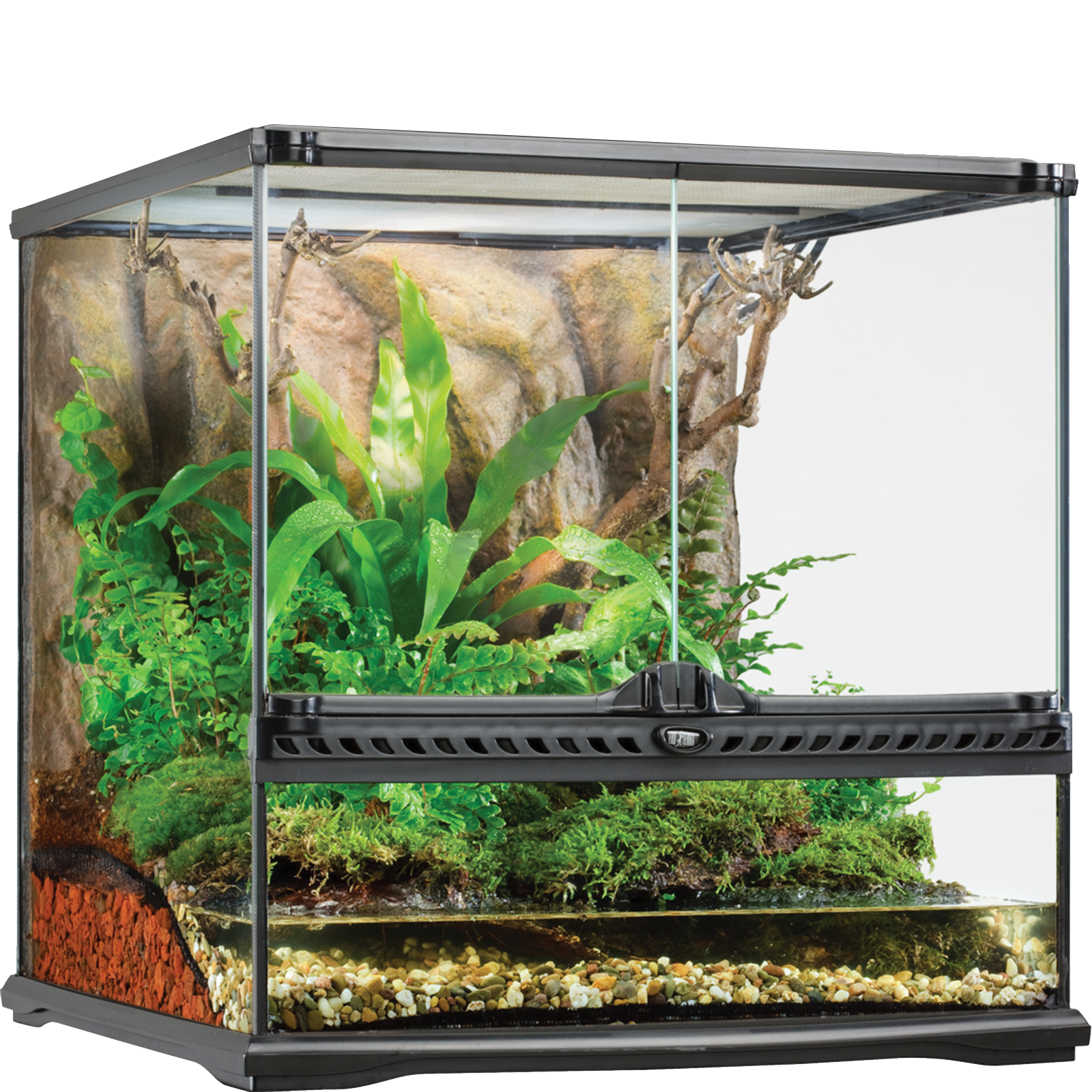
1. Exo Terra: Exo Terra are well-known for their premium reptile and amphibian terrariums, but they lack specialization in insect breeding, including beetles. Their vivariums have well-designed ventilation systems and access points for maintenance see Figure 5. Nevertheless vivariums do not include integrated electronic components such as lighting systems, necessitating the purchase of additional accessories. Exo Terra vivariums are premium-quality but also expensive. Here are the different option proposed by Exo Terra: [Exo Terra, 2024].

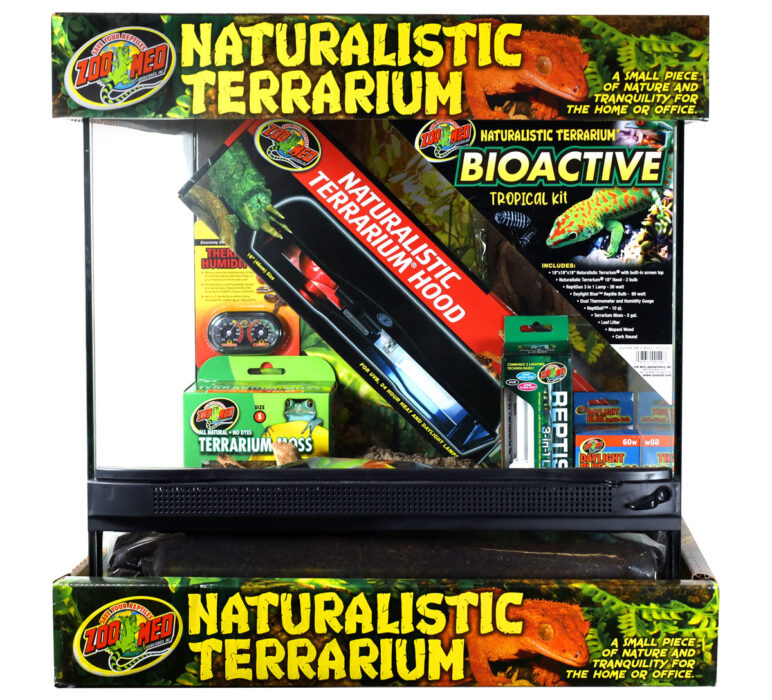
2. Zoo Med: Zoo Med focus on vivariums for reptiles and amphibians, lacking specific options for beetles. They offer starter kits see Figure 6, including only vivariums’ information for the Blue death feigning beetle [Zoo Med, 2024]. These kits are less adaptable compared to Scarabreed's offerings. Zoo Med's vivariums might be enough for personal use but might not meet the needs of professional breeders due to their lack of specialization and modularity. Additionally, their non-modular designs may limit their suitability for maximizing space efficiency in multiple-setup environments.

3. Josh's Frogs: Josh's Frogs offer a large selection of terrariums to accommodate different species of insects, reptiles, and amphibians see Figure 7. The large array of species on their website could be considered as a drawback for some. This lack of specialisation could result in less tailored products and services compared to brands that concentrate solely on beetle breeding or another specific species. With Josh's Frogs, the consumer needs to purchase individual components separately including a vivarium already quite expensive [Josh’s Frogs, 2024]. Indeed, customers must buy electronic systems, the vivarium structure itself, and decorations separately, which would increase the cost. They often provide customizable options to meet specific requirements but the absence of modular designs could limit the flexibility desired for those managing multiple setups within confined spaces.

2.6 Conclusion
The researches for the state of the art in insect vivariums, breeding initiatives, and public awareness campaigns show the importance of beetles in our ecosystem. By comparing existing practices and technologies to Scarabreed, several key insights emerge.
Firstly, the integration of insect breeding devices into educational settings represents an impactful approach to public engagement and awareness. Scarabreed aims to foster a deeper understanding of insect ecology and conservation.
Additionally, the International Union for Conservation of Nature (IUCN) Red List is a tool in order to prioritize conservation efforts and guide breeding initiatives. By using the data provided by this List, Scarabreed can make informed decisions regarding species conservation and breeding priorities to maximize their impact on endangered beetle populations.
Furthermore, existing vivarium brands have a lack of specialization and modularity within the beetle breeding market. Exo Terra, Zoo Med, Josh's Frogs and other brands offer a large range of products, Scarabreed distinguishes itself through its focus on beetle breeding and its commitment to modular design and sustainability.
In conclusion, Scarabreed wants to revolutionize the field of beetles vivariums and breeding devices through innovative approach and by focusing on ecological goals. By empowering educators, researchers, and enthusiasts with the tools and knowledge needed to conserve endangered beetles, Scarabreed aims to build a more sustainable future for insect populations and ecosystems worldwide.
Table 4 details an overview of the different brands that were analyzed in the state of the art part.
| Brand | Product | Price(€) | Functionality | Target Audience | Specialization |
|---|---|---|---|---|---|
 |  | 100 - 400 | Versatile and easy adaptable terrarium | Semi-professional and professional | Reptiles and amphibians |
 |  | 50 - 150 | Starter Kit for beginners and terrarium | Beginners and enthusiasts | Reptiles, amphibians, aquatic species and insects |
 | 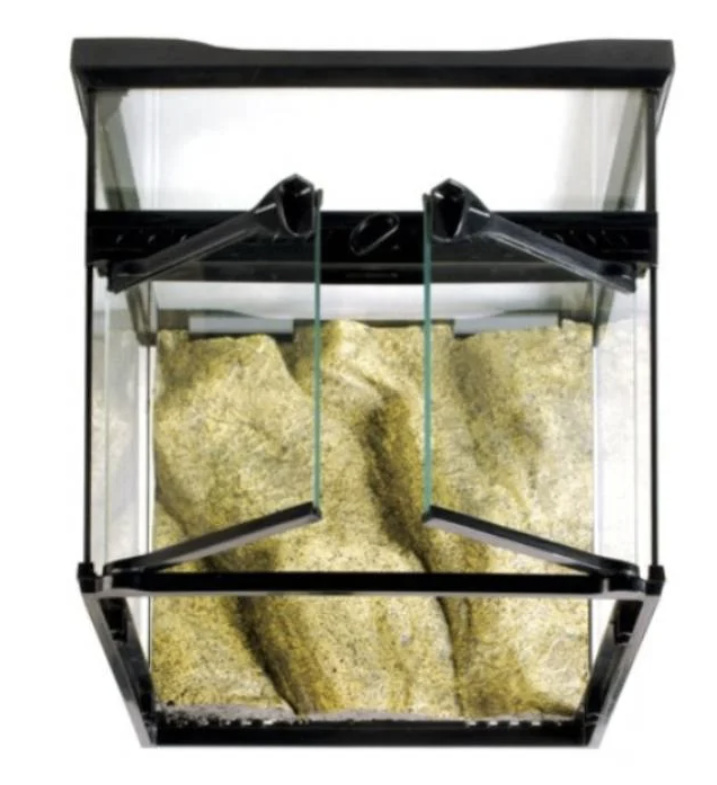 | 150 - 400 | Different size and form of terrarium adaptable for different species | Beginners, semi-professional, professional, enthusiasts | Reptiles, amphibians, arachnid, some insects |
This is how Scarabreed can differentiate itself:
Automated Environment: Sensors/ Programmable controllers to maintain precise temperature & humidity & and lighting levels
Modular Design: Scalability, customization, transportable
Data Logging and Monitoring: Real-time monitoring of environment & tracking breeding performance such as egg production and developmental rates
Sustainability and environmental improvements: Eco-friendly materials & renewable substrates & energy-efficient lighting & recyclable components
User-friendly interface: Intuitive interface for easy setup, maintenance, and data interpretation, experienced beetle breeders
3. Project Management
This chapter will address the topic of project management. It will present a comprehensive overview of the practical aspects of project management, including key elements such as stakeholders, costs, procurement, scope, and time. Project management is a crucial discipline because it facilitates the formation of a highly organised team. This, in turn, leads to the successful completion of a project that aligns with the needs of stakeholders, meets the desired scope, and provides team members with a sense of fulfilment and satisfaction. This chapter will also examine the project management approach employed by Scarabreed.
3.1 Scope
The scope of a project includes the framework required to achieve a successful result. It is detailed in a work breakdown structure (WBS), showed in Figure 8 and 9, which serves as a tool for analyzing and organizing project components for efficient management. The WBS allows for flexibility as project components and sub-components can be added to provide a comprehensive overview of the project's progress and requirements. Using the WBS minimizes the risk of failure and support the project management.


3.2 Time
In addressing the time management aspect, numerous factors come into play. The EPS project encompasses not just the project itself and its corresponding deadlines but also includes a set of courses. The EPS project at ISEP incorporates the following courses:
- Energy & Sustainable Development
- Ethics & Deontology in Engineering
- Marketing & Communication
- Portuguese
- Project Management & Teamwork
Table 5 details all the project deadlines that must be met and submitted.
| Date | Deadline |
|---|---|
| 24/02/2024 | Choose a project |
| 06/03/2024 | System Diagrams & Structural Drafts |
| 08/03/2024 | Project Backlog & Global Sprint Plan |
| 13/03/2024 | List of Components and Materials |
| 20/03/2024 | System Schematics & Structural Drawings |
| 07/04/2024 | Interim Report and Presentation |
| 11/04/2024 | Interim Presentation |
| 17/04/2024 | 3D model video |
| 23/04/2024 | List of Materials |
| 30/04/2024 | Refined Interim Report |
| 15/05/2024 | Packaging solution |
| 28/05/2024 | Functional Tests |
| 16/06/2024 | Final Report |
| 20/06/2024 | Final Presentation |
| 25/06/2024 | Update the wiki |
| 27/06/2024 | Prototype and user manual |
3.3 Cost
This project revolves around building a prototype - a functional, scaled-down version of the final product. Cost-effectiveness is key, as ISEP has given a budget of 100€. With this, all materials and components must be met. In the subsection “procurement” more info is given on which suppliers are used and which criteria are important for procurement.
3.4 Quality
Quality assurance comprises two principles:
- “Fit for purpose” - the product should be suitable for its intended purpose;
- “Right first time” - errors should be avoided.
Quality assurance encompasses the management of the quality of raw materials, assemblies, products and components, production-related services as well as management, production and testing processes. The two principles also manifest themselves against the background of the development (engineering) of a new technical product: the task of engineering is to ensure that it works once, the task of quality assurance is to ensure that it always works [Larry Smith, 2001].
Scarabreed is a company that specialises in the production of breeding equipment for endangered species. It attaches great importance to quality, as it deals with endangered species. Some of the key factors that Scarabreed must consider when maintaining quality standards include:
- Quality of staff & teamwork
- Quality of products
- Quality of materials and components
- Quality of time
Quality assurance encompasses the management of the quality of raw materials, assemblies, products and components, production-related services as well as management, production and testing processes. The two principles also manifest themselves against the background of the development (engineering) of a new technical product: the task of engineering is to ensure that it works once, the task of quality assurance is to ensure that it always works [Minakshi Jain, 2022].
When evaluating product quality, the fulfilment of requirements is fundamental to user satisfaction. To ensure product quality, certain conditions must be met, including final selling price, intended end use, dimensional specifications, reliability, service life, production requirements and maintenance objectives with associated costs. Both the quality of the design and the quality of the product are crucial factors in achieving an excellent overall product.
When selecting the materials and components for the design of the Breeding equipment, Scarabreed places great importance on sustainability and reducing the environmental impact. By choosing natural materials, the consumption of non-renewable resources is minimised and recyclability is ensured. The selection not only fulfils the requirements for human safety against external influences, but also promotes the use of renewable materials for long-lasting products.
Time management is one of the most important elements in project realisation. It serves as a guiding factor that is closely linked to project objectives and budget constraints. Efficient time management ensures that projects stay on schedule and within the parameters set. Time efficiency plays a crucial role in achieving project goals within the specified time frame.
When evaluating products or services, quality is a decisive criterion for consumers. It is essential for companies to satisfy consumer needs, which depend on market conditions, competition and consumer preferences.
Ultimately, the fulfilment of these quality standards is the basis for a successful company.
3.5 People
It is very important to find the right people for a project to be successful. These stakeholders are involved and have a stake in what happens. It is important to know who these people are so that they can be managed. In Table 6, find out who is involved in the project, what they do, how much influence they have and how much power they have.
| Stakeholder | Role | Power | Interest |
|---|---|---|---|
| Team members | Owners | High | High |
| Benedita Malheiro | EPS coordinator | High | High |
| Supervisors | Supervising the project development | High | Medium |
| Teachers | Providing resources and support | High | Medium |
| ISEP | Main sponsor | High | Medium |
| Environmentalists | Main target Group | High | High |
| Local Business | Cooperations/Sponsors | Low | Medium |
| Competitors | External influence | Medium | Low |
3.6 Communications
Effective communication within a team is important for the successful completion of a project. Without clear and continuous communication, team members may work in bubbles, overlap in their work or overlook important information. Conflicts and misunderstandings can arise, slowing down work and delaying the project. By encouraging open communication within the group, team members can share ideas, concerns and news, which improves understanding of the project's goals and specifications. This can increase productivity, focus everyone's efforts towards a common goal and ensure that the project is completed on time and within budget. In addition to promoting positive team dynamics, effective team communication can also increase team members' motivation and job satisfaction.
The two main forms of communication in our team are verbal and written. Most of our weekly project meetings with supervisors and face-to-face meetings after class involve verbal communication. These meetings ensure that everyone involved is on the same page and can discuss important information in person. Small or quick concerns are written directly in a WhatsApp group. This group can also be used as a backup for meetings if we are unable to attend in person. Teams is also used to communicate with teachers and things can be discussed quickly. Our communication strategies have generally worked well to keep everyone up to date throughout the project.
3.7 Risk
This section identifies the risks. Each risk is evaluated based on its probability of occurrence and potential impact on the project. The probability and impact both have 5 categories. Together, these two values will give an insight in the severity of each risk. By using the 5 x 5 matrix in Figure 10, a plan for dealing with these risks is developed [Patricia Guevara, 2024].

Below are the risks at product and project level. These are assessed based on the 5 x 5 matrix. Once the score is determined, a risk response is linked to it. By assessing how big a risk is, a strategy can be drawn up. This can be found in the last column of Table 7.
Product-level risks:
- Availability of components: Problems in finding key electrical components within budget or with desired specifications. This may lead to delays or affect functionality.
- No reproduction possible: The beetles may not be able to reproduce because Scarabreed cannot properly meet the habitat requirements for the beetles.
- Material incompatibility: Enclosure materials may not be suitable for the required temperature or humidity, which may affect the health of the beetles.
- Manufacturing problems: Problems during construction due to design complexity or limited resources.
Project-level risks:
- Scope Creep: The initial scope of the project may not be clearly defined, leading to unforeseen requirements that increase complexity and possibly exceed budget or timeline.
- Communication Issues: Poor communication both within the team and with stakeholders (ISEP) can lead to misunderstandings or missed deadlines.
- Supplier delays: Even with reliable suppliers, unexpected delays in the delivery of components can occur thereby disrupting the project timeline.
- Budget constraints: The allocated budget of 100€ may be too little to cover all costs. This is about foreseen and unforeseen costs.
The different risk responses are:
- Avoid; Eliminate the cause and thus, eliminating the threat.
- Mitigate; If the risk cannot be eliminated, try to reduce its impact.
- Transfer; Transfer the risk to some other party.
- Accept; Accept it will happen, plan for contingency if possible.
In this table the risk management will be showed.
| Risk | Probability | Impact | Score | Response | Strategy |
|---|---|---|---|---|---|
| Product level | |||||
| Availability of components | 1 | 3 | 3 | Accept | Make backup plan for components |
| No reproduction possible | 3 | 5 | 15 | Mitigate | Make sure the beetles have the most optimal conditions |
| Material incompatibility | 2 | 4 | 8 | Avoid | In the Bill of Materials (BOM) make sure these materials have enough capabilities to withstand the different climates |
| Manufacturing problems | 2 | 4 | 8 | Mitigate | Check each other's work or ask teachers |
| Project level | |||||
| Scope Creep | 3 | 3 | 9 | Avoid | This will be rediscussed with the group to have everyone on the same page |
| Communication Issues | 3 | 3 | 9 | Avoid | Organise a well structured meeting and make sure all parties are involved |
| Supplier delays | 2 | 2 | 4 | Transfer | If there is a problem will delivery times, Scarabreed will search for a different supplier |
| Budget constraints | 4 | 4 | 16 | Avoid | Buy cheaper material or include less features |
3.8 Procurement
Based on the limited budget of 100€ for the prototype and the need to minimise costs, Scarabreed opted for a make approach for the insect breeder. This allows the technical team to use their expertise to build the prototype itself.
To ensure efficient procurement within the project's budget and timeline, the team identified several well-established suppliers in Portugal known for their fast delivery times and high-quality products:
- Mouser
- Farnell
- Digikey
- RS
- Leroy Merin
Bill of Materials (BOM) and supplier sourcing:
The technical team creates a detailed Bill of Materials (BOM) describing all the components needed for the prototype. After completion, the BOM is used to find the most cost-effective and time-efficient supplier for each component.
Selection criteria:
- Price: Scarabreed will prioritize competitive prices without compromising on quality. Quotes should be requested from each supplier for comparison.
- Delivery time: Meeting the project timeline is crucial. Suppliers with fast delivery times are preferred to avoid delays
By implementing this procurement strategy, Scarabreed can acquire the necessary components for their insect breeder prototype within budget. The focus on reliable suppliers known for quality and fast delivery minimizes the risk of delays and ensures the team has the best materials to build a successful prototype. For the materials of the prototype, Leroy Merlin was used as a supplier because of the short transportation time. Furthermore, everything that was needed was in stock.
3.9 Stakeholders Management
Earlier in this chapter, in section 3.5 Table 6, the project's stakeholders were identified. This chapter explains the strategies the team used to effectively engage these stakeholders in the project. The stakeholders were assessed based on two critical factors: power and influence over the project. Below in Figure 11 is shown what the different types of stakeholder management are [Patrick Grégoire, 2023].

There are different types of ways to engage stakeholders in the project. These are:
- Manage closely: These stakeholders require frequent and in-depth communication because of their high influence and interest.
- Meet their needs: Although they may not have much power, these stakeholders have a strong interest in the outcome of the project. There should be good communication to meet their specific needs.
- Take into account: These stakeholders are aware of the project, but their influence and importance are relatively small. Nevertheless, perspectives should be taken into account. Furthermore, major developments must be reported.
- Stay informed: Regular updates are sufficient for stakeholders with minimal influence and interest.
In the Table 8 it is shown how the different types of stakeholders are managed.
| Stakeholder | Power | Interest | Type of managing |
|---|---|---|---|
| Team members | High | High | Manage closely |
| Benedita Malheiro | High | High | Manage closely |
| Supervisors | High | Medium | Meet their needs |
| Teachers | High | Medium | Meet their needs |
| ISEP | High | Medium | Manage closely |
| Environmentalists | High | High | Meet their needs |
| Local Business | Low | Medium | Keep in account |
| Competitors | Medium | Low | Keep informed |
3.10 Project Plan
The optimal sprint duration is set at 5 working days. In this, the sprint starts on a Thursday and ends on a Wednesday. The reason for this is that Wednesdays often have deadlines. These findings are then presented on Thursday in the project meeting with the teachers, one of our stakeholders, so that feedback can be obtained immediately. In Table 9 the global sprint plan is showcased.
| Sprint | Start | Finish | Status |
|---|---|---|---|
| 1 | 26.02.2024 | 07.03.2024 | Done |
| 2 | 07.03.2024 | 13.03.2024 | Done |
| 3 | 14.03.2024 | 20.03.2024 | Done |
| 4 | 21.03.2024 | 03.04.2024 | Done |
| 5 | 04.04.2024 | 10.04.2024 | Done |
| 6 | 12.04.2024 | 18.04.2024 | Done |
| 7 | 19.04.2024 | 24.04.2024 | Done |
| 8 | 25.04.2024 | 01.05.2024 | Done |
| 9 | 02.05.2024 | 15.05.2024 | Done |
| 10 | 16.05.2024 | 22.05.2024 | Done |
| 11 | 23.05.2024 | 29.05.2024 | Done |
| 12 | 30.05.2024 | 05.06.2024 | Done |
| 13 | 06.06.2024 | 12.06.2024 | Done |
| 14 | 13.06.2024 | 20.06.2024 | Started |
In Table 10 the product backlog is found. Here all the deliverables are shown. Each deliverable of the project is a Product Backlog Item (PBI).
| PBI | Title | Status |
|---|---|---|
| A | Define Project | Done |
| B | System Diagrams & Structural Drafts | Done |
| C | Project backlog & Global sprint plan | Done |
| D | List of Components and Materials | Done |
| E | System schematics & Structural Drawings | Done |
| F | Interim Report & Presentation | Done |
| G | Interim Presentation | Done |
| H | 3D Model Video | Done |
| I | Final list of materials | Done |
| J | Interim Report | Done |
| K | Packaging Solution | Done |
| L | Functional Test | Done |
| M | Final Report, Presentation, Video, Paper, Poster, Manual | Done |
| N | Final Presentation | Done |
| O | Prototype & User Manual | Done |
| P | Poster | Done |
| R | Upload | Done |
In Table 11 is listed in which sprint which tasks has to completed. There is also mentioned which Persons are involved.
| Sprint | PBI | Responsible | Involved | Status |
|---|---|---|---|---|
| 1 | A | all | all | Done |
| 1 | B | CF, JL | all | Done |
| 1 | C | JK | JK | Done |
| 2 | D | JK | KJ, CF, JK, | Done |
| 3 | E | CF, JL | all? | Done |
| 3,4 | F | TD,MS | all | Done |
| 5 | G | MS,JL | all | Done |
| 5,6 | H | CF | CF | Done |
| 6,7 | I | JK | KJ, CF, JK | Done |
| 6-8 | J | MS | all | Done |
| 9 | K | MS | MS | Done |
| 9,10 | L | JK | KJ, JK | Done |
| 10-13 | M | TD | all | Done |
| 14 | N | MS | all | Done |
| 14 | O | JK & KJ | all | Done |
This is the first Gantt chart. The start and end dates are displayed in Figure 12. The dates may have to be adjusted in the course of the project. The colours make the diagram more vivid. Green stands for design, blue for technical implementation and planning, and red for the report. It cannot always be subdivided as many topics overlap.

3.11 Sprint Outcomes
| Sprint 1: 26.02.2024 - 07.03.2024 Velocity planned: 24 h. Real Velocity: 28 h. | ||||||||||||||||
| Product Backlog Item | Assignee | Planned Effort [h] | Completed | Notes | ||||||||||||
| Define Project | all | 4 | true | Decide the Project, Insect research and finalise problem statement | ||||||||||||
| System Diagrams & Structural Drafts | CF, JL | 4 | true | BlackBox and Structural Drafts | ||||||||||||
| Project Backlog & Global sprint plan | JK | 8 | true | Sprint Plans, Gantt Chart and Project Backlog | ||||||||||||
| Insect research | MS | 8 | true | Contact with professionals and web research | ||||||||||||
| Sprint 2: 07.03.2024 - 13.03.2024 Velocity planned: 3 d,4 h, 30 min. Real Velocity: 4 d, 6 h, 30 min. | ||||||||||||||||
| Product Backlog Item | Assignee | Planned Effort [h] | Completed | Notes | ||||||||||||
| Communication Flyer | MS | 8 | true | Creating a flyer to promote Scarabreed’s product and brand | ||||||||||||
| Fill in the Wiki | TD | 1 | true | Week Report and Weekly Meetings | ||||||||||||
| List of Components and Materials | JK | 16 | true | List of Electrical and Hardware Components | ||||||||||||
| BlackBox revise | JL | 2 | true | Communication problems | ||||||||||||
| State of the Art | KJ | 8 | true | Managing the idea of SOTA | ||||||||||||
| Sprint 3: 14.03.2024 - 20.03.2024 Velocity planned: 4 d,5 h, 0 min. Real Velocity: 6 d, 1 h, 40 min. | ||||||||||||||||
| Product Backlog Item | Assignee | Planned Effort [h] | Completed | Notes | ||||||||||||
| State of the Art research | KJ | 8 | true | Looking for similar devices | ||||||||||||
| BlackBox revise | JL | 2 | true | Focus on user interface | ||||||||||||
| System Schematics & Structural Drawings | CF | 6 | true | Focus on accuracy and clear communication to avoid having to do double work | ||||||||||||
| Cardboard scale Modell | CF | 4 | true | The drawings have to be improved | ||||||||||||
| Presentation | JL | 1 | true | Team Presentation | ||||||||||||
| Motivation | JL | 1 | true | Team Motivation | ||||||||||||
| Problem | TD | 2 | true | Problem Statement | ||||||||||||
| Requirement | MS | 2 | true | Requirements of the Project | ||||||||||||
| Objectives | TD | 1 | true | Goal of the Project | ||||||||||||
| Report structure | KJ | 0.5 | true | Inform about formation possibilities | ||||||||||||
| Project planning | JK | 0.5 | true | Project planning for the Introduction | ||||||||||||
| Functional tests | JL | 1 | true | Wiki Introduction | ||||||||||||
| Already existing breeding Devices | CF | 2 | true | Research | ||||||||||||
| Insect breeding | CF | 2 | true | Research | ||||||||||||
| Public awareness | KJ | 2 | true | Research | ||||||||||||
| IUCN RED List | MS | 2 | true | Research | ||||||||||||
| Environment | MS | 0.5 | true | Sustainability | ||||||||||||
| Introduction | JK | 2 | true | Project Management | ||||||||||||
| Cost | TD | 1 | true | Project Management | ||||||||||||
| People | JK | 0.5 | true | Project Management | ||||||||||||
| Quality | JK | 1 | true | Project Management | ||||||||||||
| Scope | JK | 1 | true | Project Management | ||||||||||||
| SWOT Analysis | JL | 0.5 | true | Marketing | ||||||||||||
| Introduction | TD | 1 | true | Marketing | ||||||||||||
| Market Analysis | TD | 3 | true | Marketing | ||||||||||||
| Strategy | JL | 3 | true | Marketing | ||||||||||||
| Introduction | CF | 1 | true | Ethics | ||||||||||||
| Engineering ethics | CF | 0.75 | true | Ethics | ||||||||||||
| Economic | MS | 0.5 | true | Eco-friendly | ||||||||||||
| Social | MS | 3 | true | Eco-friendly | ||||||||||||
| Sprint retrospective | TD | 0.5 | true | For the management teacher | ||||||||||||
| Daily standup | all | 2 | true | For the management teacher | ||||||||||||
| Sprint 4: 21.03.2024 - 03.04.2024 Velocity planned: 4 d,6 h, 25 min. Real Velocity: 2 d, 5 h, 15 min. | ||||||||||||||||
| Product Backlog Item | Assignee | Planned Effort [h] | Completed | Notes | ||||||||||||
| Marketing Presentation | TD | 3 | true | not for the report | ||||||||||||
| Environmental Ethics | KJ | 2 | true | Found good references | ||||||||||||
| Sales and marketing ethics | CF | 2 | true | Go way more into details and into the depth of this subject | ||||||||||||
| Interim presentation Canva | MS | 3 | true | good feedback | ||||||||||||
| SWOT Analysis | JL | 0.5 | true | Refine design and add more threats | ||||||||||||
| System Schematics & Structural Drawings | CF | 6 | true | More accuracy and attention to general rules of structural drawings | ||||||||||||
| Economic | MS | 0.5 | true | Took a lot more time then expected | ||||||||||||
| Environment | MS | 0.5 | true | Find important sustainable points that need to be respect | ||||||||||||
| Functional tests | JL | 1 | true | Communicating with the technical squad went good | ||||||||||||
| Public awareness | KJ | 2 | true | Digging deeper into the extinction of the insects | ||||||||||||
| Engineering ethics | CF | 0.75 | true | More depth needed | ||||||||||||
| Improve the Electrical Drawings | KJ | 2 | true | Problems with the fan | ||||||||||||
| Sprint Outcome | JK | 6 | true | Double work because everything is also in Jira | ||||||||||||
| Sprint 5: 04.04.2024 - 10.04.2024 Velocity planned: 5 d,0 h, 10 min. Real Velocity: 5 d, 5 h, 40 min. | ||||||||||||||||
| Product Backlog Item | Assignee | Planned Effort [h] | Completed | Notes | ||||||||||||
| State of the art | MS | 10 | true | Brands, product and knowledge to know before creating the brand | ||||||||||||
| Live Cycle Analysis | JL | 3 | true | Make our own LCA-image, choose what phases Scarabreed wants to focus on | ||||||||||||
| Liability | KJ | 1 | true | Doing a reserch | ||||||||||||
| Stakeholder Management | JK | 2 | true | |||||||||||||
| Procurement | TD | 2 | true | Easily done | ||||||||||||
| Risk | TD | 2 | true | Easily done | ||||||||||||
| Project Plan | TD | 2 | true | Easily done | ||||||||||||
| System Schematics & Structural Drawings | CF | 6 | true | Took a lot of time | ||||||||||||
| Sprint 6: 11.04.2024 - 17.04.2024 Velocity planned: 3 d,3 h, 30 min. Real Velocity: 5 d, 6 h, 0 min. | ||||||||||||||||
| Product Backlog Item | Assignee | Planned Effort [h] | Completed | Notes | ||||||||||||
| Create the 3D Video | CF | 24 | true | High quality rendering takes a lot of effort and is even more time consuming | ||||||||||||
| State of the art | CF | 3 | true | Took a long time | ||||||||||||
| Make list of material | JK | 8 | true | Problems with the budget | ||||||||||||
| Leaflet | MS | 8 | true | Creating a design by keeping similar Colors and design | ||||||||||||
| Sprint 7: 18.04.2024 - 24.04.2024 Velocity planned: 1 d,2 h, 40 min. Real Velocity: 3 d, 2 h, 40 min. | ||||||||||||||||
| Product Backlog Item | Assignee | Planned Effort [h] | Completed | Notes | ||||||||||||
| Ethics Presentation | JL | 3 | true | Misunderstanding of one of the guiding questions, otherwise did go well | ||||||||||||
| Final List of Material | JK | 10 | true | - | ||||||||||||
| Packaging | MS | 12 | true | Eco-responsible and reusable packaging | ||||||||||||
| Sprint 8: 26.04.2024 - 01.05.2024 Velocity planned: 0 d,1 h, 30 min. Real Velocity: 0 d, 1 h, 30 min. | ||||||||||||||||
| Product Backlog Item | Assignee | Planned Effort [h] | Completed | Notes | ||||||||||||
| Sprint retrospective | all | 1.5 | true | student break week | ||||||||||||
| Sprint 9: 02.05.2024 - 15.05.2024 Velocity planned: 3 d,5 h, 45 min. Real Velocity: 3 d, 0 h, 0 min. | ||||||||||||||||
| Product Backlog Item | Assignee | Planned Effort [h] | Completed | Notes | ||||||||||||
| Logbook | TD | 0.5 | true | No troubles | ||||||||||||
| Life Cycle Analysis | JL | 3 | true | Complete LCA-image and explain more in depth about what the phases mean | ||||||||||||
| Packaging | MS | 16 | true | Creating a design that is reusable and innovative | ||||||||||||
| Marketing Program | TD | 3 | true | Little trouble with finding the right sources | ||||||||||||
| Leaflet | MS | 4 | true | Keeping a design similar to the flyer with more and different information in a vivarium design | ||||||||||||
| Power Calculation | KJ | 1 | true | Power calculated for every part | ||||||||||||
| SWOT update | JL | 1 | true | Updated design and colors in the image matching Scarabreed logo, also added more threats | ||||||||||||
| Conclusion Sustainability | JL | 1 | true | Easily done | ||||||||||||
| Black Box | JL | 1 | true | Refined version | ||||||||||||
| Material Comparision | JK | 12 | true | The amount of the material is missing | ||||||||||||
| Sprint 10: 16.05.2024 - 22.05.2024 Velocity planned: 8 d,5 h, 0 min. Real Velocity: 6 d, 6 h, 20 min. | ||||||||||||||||
| Product Backlog Item | Assignee | Planned Effort [h] | Completed | Notes | ||||||||||||
| Marketing for the Overleaf | TD | 2 | true | Teacher reviewed and it was good | ||||||||||||
| Ethics for the Overleaf | TD | 2 | true | Teacher reviewed and it was good | ||||||||||||
| Sota for the Overleaf | MS | 2 | true | Teacher reviewed and it was good | ||||||||||||
| Introduction for the Overleaf | JL | 2 | true | Word limitations | ||||||||||||
| Sustainability for the Overleaf | MS | 2 | true | Teacher reviewed and it was good | ||||||||||||
| Hardware Comparison | KJ | 2 | true | Filled in all the comparable hardware | ||||||||||||
| Life Cycle Analysis | JL | 2 | true | No problems | ||||||||||||
| FEM for the CAD Model | CF | 4 | true | Redefining fixture point | ||||||||||||
| Power Calculation | KJ | 2 | true | |||||||||||||
| Sprint 11: 23.05.2024 - 28.05.2024 Velocity planned: 3 d,2 h, 40 min. Real Velocity: 4 d, 6 h, 30 min. | ||||||||||||||||
| Product Backlog Item | Assignee | Planned Effort [h] | Completed | Notes | ||||||||||||
| Building the Prototype | JK | 8 | true | Takes a lot of time | ||||||||||||
| Software in Prototype | KJ | 2 | true | A lot of basic problems, fan connection is mystery | ||||||||||||
| Hardware in Prototype | JK | 3 | true | No problems | ||||||||||||
| Project Development for the Overleaf | JK | 2 | true | The text had to be very short | ||||||||||||
| Conclusion for the full Report | TD | 2 | true | Global overview of the wiki | ||||||||||||
| Code for Micro-Controler | KJ | 8 | true | Trying and failing | ||||||||||||
| 3D-Video | CF | 16 | true | Very time consuming and technical features needed to be added | ||||||||||||
| Sprint 12: 30.05.2024 - 05.06.2024 Velocity planned: 4 d,3 h, 20 min. Real Velocity: 1 d, 2 h, 0 min. | ||||||||||||||||
| Product Backlog Item | Assignee | Planned Effort [h] | Completed | Notes | ||||||||||||
| Building the Prototype | JK | 8 | true | Takes a lot of time | ||||||||||||
| Code for Micro-Controler | KJ | 8 | true | More success the I2C is working | ||||||||||||
| 3D-Video | CF | 16 | true | Very time consuming | ||||||||||||
| User Manual | MS | 4 | true | creating the design and the summary of the user manual | ||||||||||||
| Conclusion for the Overleaf | TD | 1 | true | Global conclusion given about the different parts | ||||||||||||
| Sprint 13: 06.06.2024 - 12.06.2024 Velocity planned: 4 d,4 h, 55 min. Real Velocity: ! d, ! h, ! min. | ||||||||||||||||
| Product Backlog Item | Assignee | Planned Effort [h] | Completed | Notes | ||||||||||||
| Building the Prototype | JK | 8 | true | Takes a lot of time | ||||||||||||
| Code for Micro-Controler | KJ | 8 | true | Well done | ||||||||||||
| 3D-Video | CF | 16 | true | Well done | ||||||||||||
| User Manual | MS | 4 | true | Giving all the information about the product to protect the user and the brand | ||||||||||||
| Update the Wiki | all | 4 | true | Many small things need to be improved | ||||||||||||
| Sprint 14: 13.06.2024 - 20.06.2024 Velocity planned: 4 d,0 h, 00 min. Real Velocity: - d, - h, - min. | ||||||||||||||||
| Product Backlog Item | Assignee | Planned Effort [h] | Completed | Notes | ||||||||||||
| Update the Wiki | all | 4 | true | Many small things need to be improved | ||||||||||||
| Final Presentation | MS | 4 | true | Trying to resume 5 months of project into a 10 min presentation | ||||||||||||
| Practising the Presentation | all | 16 | false | |||||||||||||
3.12 Sprint Evaluations
In this paragraph, the sprint evaluations are shown in Table 13. Here the positive and negative outcomes are described.
| Sprint | Positive | Negative |
| 1 | Teamspirit is good | Everyone still needs to figure out Jira |
| 2 | Decision-making for the project went smoothly, the assignment the team got was preferred | Team still needs to figure out Jira |
| 3 | Everyone is well aware of the tasks at hand | Tasks get pushed towards the end of the deadline |
| 4 | Time logging is implemented, Team works in a structured way | Not all tasks were done due to a big backlog and vacation |
| 5 | The team worked great together to finish all the tasks in the sprint | Sometimes teammates had to wait for other teammates to start, this communication wasn't good |
| 6 | Important deadlines were met like the materialist, 3D video, and the wiki | After the presentation the team took it a bit easier. The standups have to be more present during meetings |
| 7 | Now entering the second phase which is building, the team is well prepared | People were on vacation so tasks got pushed back |
| 8 | Team came a long way in the material list and Ethics presentation | This week we didn’t communicate well with the tasks still at hand |
| 9 | The team held a meeting during the vacation, and everyone knew what to do. It's well organised | Teammates were waiting on others but they didn’t get what they need |
| 10 | Project backlog was filled and tasks were distributed | Teammates were still waiting on others but they didn’t get what they needed |
| 11 | Big sprint towards finishing the Overleaf, communication went very well regarding finalising certain parts in Overleaf | Need to be more focussed on finishing electro |
| 12 | The End is near and everybody is focussed on finishing the tasks at hand | Some people take too long on their tasks, and need to check the spelling and grammar of the texts written |
| 13 | Finished the Overleaf report, made a the final project backlog to see what still needs to be done to finish the whole project | People have to wait on previous tasks who are still not finished |
| 14 | The prototype is finished and the deadline of the 16th of June is finalised. Now only presentation is needed | No negatives |
| 15 | Presentation went well, team works hard fixing the feedback | No negatives |
3.13 Conclusion
This chapter provides a comprehensive insight into how the project team will proceed this semester. For instance, the team ensures a clearly defined assignment with valid problem definition. In doing so, the team ensures that key stakeholders are taken into account and that the project's milestones are met with a good planning. A good foundation is laid so that the team can focus on other issues. The next chapter describes marketing. This looks at how Scarabreed can best set up its marketing to sell the product in the best possible way.
4. Marketing Plan
This chapter looks at how Scarabreed can market its product. A market analysis describes what types of people are addressed by the beetle breeder. A Strength, Weakness, Opportunity, and Threat analysis (SWOT) emerges from the market analysis. From this, a strategy is formed focusing on segmentation, positioning, and targeting. From this, the marketing program is again designed after which Scarabreed has a well-organized marketing approach.
4.1 Market Analysis
This market analysis examines the potential for Scarabreed, a company specialising in beetle breeding solutions. We examine two main areas:
- Macro Analysis: This section uses the PESTEL framework to analyse external factors, such as political regulations, economic trends and environmental considerations that may affect Scarabreed's business.
- Micro Analysis: This section focuses on the specific needs and motivations of Scarabreed's target market. This is where the value proposition is shown.
By understanding both external and internal factors, this analysis aims to provide a detailed picture of the beetle breeding market and Scarabreed's position in it.
4.1.1 Macro Analysis
In this subchapter, the PESTEL analyses will be used. PESTEL is an abbreviation for Political, Economic, Social, Technological, Environmental and Legal. By conducting a PESTEL analysis, Scarabreed can gain a better understanding of the external environment and identify potential opportunities and threats. This information can then be used to develop strategies for success.
Political:
- The Convention on Biological Diversity's (CBD) ambitious goals for biodiversity restoration by 2030 presents a significant opportunity for Scarabreed [Convention on Biological Diversity, 2024]. Scarabreed's innovative vivarium can directly support these efforts, aligning itself with critical government priorities and potentially attracting grant funding or program support.
Economic:
- A significant amount of funding currently goes towards activities that harm nature, there's a growing trend of investment in Nature-based Solutions (NbS). This is positive for Scarabreed because their beetle breeding vivarium directly contributes to NbS efforts. As awareness and investment in NbS increases, Scarabreed's market potential also grows [Abby Schultz, 2024].
Social:
- The national garden survey shows that more people are planting native plants to improve biodiversity [Caitlyn Fallon, 2022]. This means that people are busy with helping insects.
- Social media could be used to create more awareness about the importance of insects.
- Invest a portion of revenues in nature-based solutions to create more awareness.
Technological:
- The topic of insect farming is getting bigger. These technical capabilities could inspire environmentalists to breed insect, not to eat, but to set free to help ecosystems [Martina Igini, 2022].
- Progress in 3D printing technology has the potential to revolutionise Scarabreeds product offering. Customisation of vivarium modules to meet the specific needs of a wider range of beetle species could be made easier, which would further add to the product's appeal and match students' growing interest in science projects.
Environmental:
- Researchers warn that climate change may lead to a crisis among crucial insect populations, threatening ecosystems worldwide. The decline in insect populations due to climate change could have far-reaching consequences for biodiversity and food security [Adam Yamaguchi, Kerry Breen, 2024].
- The UN organizes multiple projects to restore ecosystems all around the world [United Nations Environment Programme, 2024].
Legal:
- The European Green Deal's focus on environmental restoration, with regulations promoting reduced emissions and increased nature preservation, creates favourable conditions for Scarabreed [European commission, WD].
4.1.2 Micro Analysis
This is the value proposition pitch for Scarabreed’s product. The key points can be found in Figure 13.

4.2 SWOT Analysis
Scarabreed's innovative beetle vivarium positions them well in the growing insect conservation market. Here's a breakdown of their strengths, weaknesses, opportunities, and threats (SWOT). In Figure 14 the different topics are put in an overview.
Strengths:
- Breed beetles to preserve ecosystems: The BBV2 will be a user-friendly, space-saving vivarium with integrated electronics that simplify beetle breeding, making it accessible to a broader audience.
- Aligned with Sustainability Goals: Scarabreed's vivarium directly supports government biodiversity restoration goals and the Nature-Based Solutions (NBS) movement, attracting potential funding and aligning with critical environmental initiatives.
- Integrated electronics: The integrated electronics will make sure the user receives a more complete product which makes it time- and cost- efficient to the customer.
- Customization and Scalability: The modular design allows customization for various beetle species and potential scaling for larger conservation efforts, catering to both hobbyists and citizen science projects.
Weaknesses:
- Limited Market Awareness: Scarabreed might face competition from established players or lack awareness about its innovative product in the insect breeding market.
- No mass production of beetles: The Scarabreed Beetle Breeder Version 2 (BBV2) is not made for mass production of beetles.
Opportunities:
- Growing Public Interest: The increasing public focus on biodiversity and insect conservation creates a receptive market for Scarabreed's vivarium.
- Social Media and Educational Outreach: Utilizing social media and educational campaigns can raise awareness about the importance of insects and promote Scarabreed's solutions.
- Favorable regulatory environment: The European Green Deal's focus on environmental restoration creates favourable conditions for Scarabreed.
- Donations to nature organisations: Donate a percentage of each customer purchase to nature organisations
- Educate students in early school life: Educate students in early school life, the product can be used as an educational tool for instance as a project in the subject of biology. Resulting in more nature-oriented students early in life, that will lay a foundation for future adult life.
Threats:
- Focus on Large-Scale Insect Farming: The industry focus on large-scale insect farming for food production might overshadow the importance of insect breeding for conservation efforts.
- Ignorance of Ecosystems in Society: As a result of people's lack of concern, it can be simple to overlook and ignore the important role that insects and beetles play in ecosystems and to feel no motivation to help with preserving them.
- Old-fashioned Beetle Breeding: The product might be disregarded by some because of the “already working” method of reproducing insects, for instance by using a cardboard box.

4.3 Strategy
Scarabreed's strategic goals are outlined in this framework, which emphasizes user-centered design, affordability, and sustainability. Scarabreed hopes to carve out a distinct niche for itself in the industry by focusing on particular market segments and utilizing a dynamic marketing approach. In addition to providing a better product, Scarabreed aims to foster a greater appreciation for nature via teamwork and ongoing education.
4.3.1 Strategic Objectives
Economical objectives
- Create a multi-purpose product that is efficient and sustainable.
- Create the best possible product for the lowest price.
- Production to have the lowest possible impact on the climate.
- Enter a growing market with a high-quality product.
Customer objectives
- Spread awareness about the need of restorations of eco-systems and why it is crucial for life on earth
- Offer users a high-quality product that helps them preserve the ecosystem on their own.
- A modular and aesthetic product that the customer gets to adjust themselves.
Technological objectives
- The product is equipped with a monitor screen for the user to observe the beetles.
- Mechanical and electrical components so the product is as user-friendly as possible.
Learning objectives
- Improve English language skills
- Work in a team with students from different cultures and educational backgrounds.
- Educate ourselves in other fields than our own field of study.
4.3.2 Segmentation
To define a strategy for the product. The team uses the STP method which stands for Segmentation, Targeting and Positioning, to create an effective marketing strategy.
- Demographical segmentation
The demographic segmentation is both people and organizations. People between the ages of 30-70 are most likely to have a steady income, live in their own house and show interest in nature and the climate. Also, they are likely to be interested in beetle breeding as a hobby. People working within education such as biology teachers can use this product as a tool for educating students. Organizations that would be interested in this product are those who are actively involved in preserving the environment and working towards a better future.
- Geographical segmentation
The product is fit for large parts of the world but is geographically the best fit for countries in the Northern hemisphere. A well-developed country would be a great target. People living in rural areas may have an easier time using the product. In parts of the world where extreme weather conditions could occur are not to be recommended for the product due to malfunction risks with the electronic components. However, in favour of the electronic components the product can adjust the temperature accordingly.
- Behavioral segmentation
The end user is interested in contributing to a healthier planet and likes to take matters into their own hands.
4.3.3 Targeting
Scarabreed's target population include individuals that want to take responsibility and foster biodiversity with their own hands and from their own home. Simultaneously, the team targets organizations working with ecological preservation moreover formal organizations such as schools and educational centers. The aim is to educate students about the value of nature in early childhood-education, the prime area for development and learning, to lay foundations for future adult life.
The target group can be defined as individuals:
- With a mid/high income level
- With post- secondary education
- Who are patient, calm and eager to learn
- Who live in rural areas
- Who are aware of eco-systems vital purpose or want to learn more about it
- Working within education, such as teachers
- Who are interested in contributing to a better future with their own hands
- That are looking for a new experience
- With previous knowledge and/or interest in insects
The target group can also be defined as organizations and educational institutions:
- Working with questions regarding the environment and nature
- Educating students about the value of nature
- Spreading knowledge about insects' value in eco-systems
- Wanting a new product that can be used for educational purpose, e.g. as a project for biology subject
4.3.4 Positioning
In comparison to companies offering similar products and services on the market, Scarabreed will be positioned differently on the market since the marketing strategy is quite different. After research, the team found that most of the existing companies in this area, breed the insects to use them in food for either animals or humans. Whilst Scarabreeds' product aims to breed endangered beetles for preservation of the ecosystem. There are several companies, as seen in Figure 15, that create vivariums for domestic use. However unlike Scarabreed, these vivariums offer limited modularity and electronical functions.
As previously described, the product that Scarabreed is producing is not on the market, the team considers this an advantage. The product will be more expensive than a cardboard box for breeding beetles in, but will offer better quality, functionality and is more righteous. Scarabreed wishes to be perceived, by their customers, as a team that offers a good product with a fair amount of functionality at a decent price.

4.3.5 Marketing-Mix
The marketing mix refers to the set of actions, or tactics, that a company uses to promote its brand or product on the market. This method includes four key elements, “the four Ps” – product, promotion, place and price, see Figure 16.
- Product refers to the product or the service that the company provides. It includes things such as features, design, packaging, and quality. It is important that the company can meet the needs of their target customers and differentiate themselves from their competitors.
Scarabreed's vivarium seamlessly blends aesthetics with integrated electronics, making it easy to contribute to a healthier ecosystem through user-friendly technology. Furthermore, its modular design allows for customization, giving customers the freedom to personalize their vivarium and create a perfect fit for their space and preferences.
- Promotion refers to the different methods a company can use to reach out to its target customers.
Scarabreed will prioritize modern advertising channels to reach their target audience efficiently and cost-effectively. This includes digital marketing strategies. Additionally, the team will seek partnerships with relevant organizations, such as nature organizations and educational institutes, for product testing and feedback. Furthermore, Scarabreed will donate samples to educational institutions and decision-makers, sparking interest and potentially integrating the vivarium into educational programs.
- Place, the channels and locations a company uses to distribute its products or services. The company must ensure that their product is available in the right places at the right times to meet customer demand.
To effectively engage potential customers, Scarabreed prioritizes a visually appealing website with comprehensive product descriptions. The website will also feature a dedicated customer service team to promptly address any inquiries or concerns. Scarabreed will offer the vivarium for purchase through the online store, reaching customers worldwide. The team maintains a readily available inventory for immediate shipment while strategically adjusting stock levels based on customer demand.
- Price, the amount of money a company charges for their product or service. This is usually determined by factors such as production costs, competition, and customer demand.
The price of the product is still unclear since the final draft is not yet set. Also, since there are no exact similar products on the market, it is difficult to estimate the price of this product. However, this gives an advantage in pricing the product, since there are no direct competitors it is not neccessary to take this into consideration when pricing the product. However, it is clear that in order to reach the target population, the product must have a reasonable price.

4.3.6 Brand
The name of the product is Scarabreed, which stems from French “scarabeé” and Latin “scarabaeus”, which is an umbrella term for Afro-Eurasian beetle species. The scarab was a famous form of sacred amulet and considered divine by the ancient Egyptians because of its religious and historic significance, symbolizing the morning sun. The other part of the name Scarabreed, comes from the English word “breed”. Which connects the product to its name and purpose. The logo, which is displayed in Figure 17, has a color of dark navy blue which is often associated with knowledge, authority, and reliability, likewise linked to consciousness. These characteristics are what Scarabreed wants to be a picture of. The team also implemented an illustration of a beetle into the logo to give the viewer an immediate idea of what the brand is about [Kara Rogers, 2024].
4.4 Marketing Programmes
In this section, Scarabreed is going to point out how it will bring awareness of its product to the target audience. Also, there is thought about how to budget for flyers and leaflets. These are vital for the spreading of awareness. When the target audience is interested in the BBV2, Scarabreed will have to make sure to keep the target audience attached, this will be shown in the part of control.
4.4.1 Programmes
To have as much exposure as possible for Scarabreed, the company is planning on working with nature organizations such as World Wide Fund for Nature (WWF) and The Nature Conservancy. These organizations have a wide range of projects to which Scarabreed can contribute by active restoration. This means that ecosystems are being restored with native plants and animals. In collaborating with nature organizations Scarabreed could even better its product by updating designs and adding specifications to specify different types of restoring projects.
Scarabreeds goal is to preserve ecosystems worldwide. The company wants to inspire the new generation to ensure this keeps happening. To do this, Scarabreed will partner up with schools to create more awareness about preserving nature. By doing this scarabreed can promote its product but also make sure students work with the BBV2 to get a feeling of what it's like.
To further reach the target audience Scarabreed is going to make YouTube videos and social media content. This will increase the name recognition which will eventually lead to more sales. In this online marketing program the company will show how its products work.
4.4.2 Budget
Table 14 shows the budgeting of the marketing programmes. The table displays the overall budget and its allocation. Scarabreed wants to spread as much awareness as possible so it invests heavily in a well-functioning site, flyers and online marketing to reach people all over the world.
| Income | Price [€] | Link |
|---|---|---|
| Budget | 1200 | |
| Expenses | ||
| Leaflets | 60 | [360imprimir, 2024] |
| Posters | 70 | [360imprimir, 2024] |
| Owned Media (Website) | 288 | [Shopify, 2024] |
| Video Advertising (Youtube) | 100 | – |
| Social Media Advertising (Facebook, Instagram) | 482 | – |
| Total | ||
| Income | 1200 | |
| Expenses | 1018 | |
| Differential | 182 |
4.4.3 Control
To ensure that marketing objectives are met, the Plan Do Check Act principle (PDCA) is used. This model ensures an iterative approach that produces better results every time. The PDCA has different cycles which are explained below, Figure 18 is a visual representation of the iterative process [Pavel Naydenov, 2024].
- Plan: Define the project and activity's goals, objectives, and methods. This involves thorough planning and outlining the steps to achieve the desired outcome.
- Do: the plan that has been developed is going to be implemented.
- Check: evaluating the results that come forth from the “Do” phase. This involves monitoring progress, analyzing data, and identifying any deviations from the plan.
- Act: Based on the evaluation, take corrective action or adjustments. This might involve refining the approach, addressing problems, or standardizing successful methods for future iterations.

- The plan was discussed in the marketing program section. This involves cooperation with nature organizations, schools, and marketing campaigns online. Important here is to develop Key Performance Indicators (KPI). These are targets against which Scarabreed can measure whether the campaign is succeeding. These goals are again measured in ‘Check’ phase.
- Do: is to actually implement the marketing campaign.
- Check: This section involves checking whether the campaign is catching on. This is done by looking at the KPIs. Examples of measurable KPIs are market share, number of sales, or number of views on YouTube and other online marketing posts.
- Act: In the ‘Act’ phase, the goals are updated to more realistic goals or more optimistic goals. By sharpening these goals, plans can again be better adjusted to make this lead to better results.
4.5 Conclusion
This chapter outlines Scarabreed's marketing strategy for their innovative beetle breeding vivarium.
Scarabreed leverages its strengths, such as user-friendly design, customization options, and alignment with sustainability goals, to position itself uniquely within the insect breeding market. Their marketing mix will focus on online promotion, global online sales, and potentially partnering with educational institutions for product testing. Empowering individuals and fostering environmental awareness is just the beginning. Chapter 5, dives into Scarabreed's commitment to minimizing their environmental footprint throughout the vivarium's lifecycle.
Based on this market and economic analysis, team Scarabreed decided to create a beetle breeding vivarium intended for home-based environmentalists and educational institutions because the individuals can take personal action for biodiversity at home whilst schools and centers that prioritize environmental education, using the vivarium to teach students about the importance of nature. Furthermore, Scarabreed wants to work with wildlife organizations to ensure that the goal, of preserving nature and breeding endangered beetles, is still being worked on. These are the core values.
Consequently, the team decided to create a product with electronic functions and a modular aesthetically pleasing design which all contribute to the product being easy to use while fostering responsibility for preserving ecosystems.
In essence, Scarabreed operates at the intersection of personal environmental responsibility and early childhood environmental education.
5. Eco-efficiency Measures for Sustainability
The eco-efficiency measures for sustainability provide a foundation for understanding our environmental responsibility and resource efficiency.
The poverty of georesources poses a significant threat to endangered beetles and their ecosystems. Georesources, including energy resources, geothermal energy, water resources, minerals, and soils, are vital elements essential for sustaining society, see Figure 19, [Law Insider, 2024]. The overuse of georesources has compromised their availability and also disrupted the delicate balance of ecosystems where endangered beetles live.
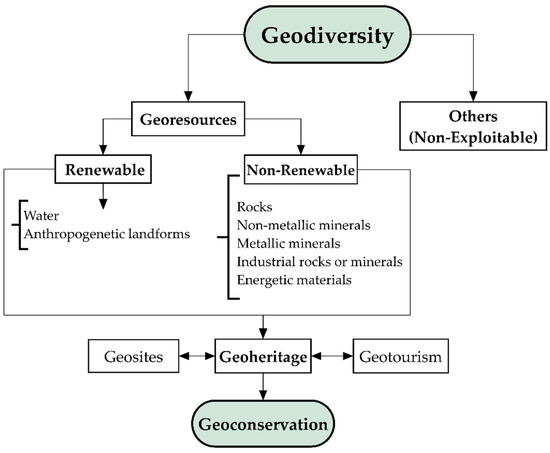
Scarabreed would like to use resources effectively, minimize waste, and promote ecosystem conservation in its beetle breeding operations in order to mitigate its impacts and contribute to the restoration of balance in their habitats.
Scarabreed is committed to following a life cycle assessment approach to minimize its environmental impact and to be sustainable. Life-cycle analysis provides a comprehensive framework for assessing the environmental impacts of products and processes. By quantifying the environmental footprint of its beetle breeding activities, Scarabreed can make informed decisions that promote sustainability and implement strategies to reduce resource consumption, minimize emissions, and optimize energy efficiency [Sphera’s Editorial Team, 2020].
Regarding sustainable development, Scarabreed would like to foster social equity, environmental integrity, and economic prosperity, Figure 20. This balanced approach ensures that Scarabreed's beetle breeding activities support thriving ecosystems [Gene Bazan, Tania Slawecki, 2002].

Scarabreed also wants to follow the Happy Planet Index which is an index that measures prosperity by the well-being of people, the life expectancy and the ecological footprint. Scarabreed strives to contribute positively to both human and ecological health through its sustainable practices. Inspired by the Happy Planet Index, Scarabreed focuses on sustainable breeding practices to minimize its environmental footprint while maximizing the well-being of the beetles [Hot or Cool Institute, 2024].
Scarabreed wants to be eco-efficient, minimize its environmental impact while maximizing its economic output. With this concept, Scarabreed demonstrates its environmental responsibility and also its focus on responsible business practices. This can resonate with a wider audience, contribute to its long-term success and attract customers who have the same values as Scarabreed [Paulo Peças, et al., 2019].
Transparency and accountability are central to Scarabreed's sustainability efforts. Through regular sustainability reporting, Scarabreed wants to communicate its environmental performance, social initiatives, and progress towards sustainability goals to stakeholders. By sharing successes, challenges, and lessons learned, Scarabreed fosters trust and engagement with its stakeholders, driving continuous improvement and innovation.
Vivariums also require some level of temperature and humidity control, which means energy use. Scarabreed uses LED lights that consume less energy than traditional incandescent bulbs. Reduced energy consumption translates to reduce operational costs and to have a smaller carbon footprint [Surple, 2021].
Scarabreed eco-efficiency recognizes the interconnectedness of environmental responsibility, resource use, and social well-being, ensuring a sustainable future for beetles and the planet.
5.1 Environmental
Scarabreed's project offers a multitude of environmental benefits :
5.1.1 Habitat Restoration and Biodiversity Increase
Beetle reintroduction programs can play a crucial role in habitat restoration efforts. Indeed, beetles play a vital role in healthy ecosystems from seed dispersal, to the pollination and decomposition [Katherine Baxter, WD].
Scarabreed's breeding program can provide the necessary boost to increase the endangered beetle's number and to develop a stable biodiversity.
5.1.2 Improved Ecosystem Functioning
Beetle populations contribute to a variety of ecosystem services that benefit the environment, see Figure 21. For instance, they break down organic matter, return nutrients to the soil and aerate the soil, which is essential for plant growth, water drainage and healthy ecosystems.

By increasing beetle populations, Scarabreed's project can contribute to the health and the functioning of the ecosystems where beetles are reintroduced.
5.1.3 Reduced Reliance on Pesticides
Certain beetle species, as predators, help to regulate pest populations and reduce the need for chemical pesticides. Pesticide use can pollute soil and water sources and we can find residues on food and beverages. In addition, pesticides have not only an impact on pests but also on beneficial insects like pollinators [The Business Times, 2024].
Scarabreed's project can help to reduce reliance on chemical pesticides. This can have a number of positive environmental impacts like protecting vital resources, ensuring safe food for consumption and protecting the ecosystem.
5.1.4 Sustainable Materials
Scarabreed prioritizes the use of eco-friendly materials in the construction of its vivariums. The materials will be renewable, biodegradable, or recycled. Scarabreed team wants to reduce the demand for virgin resources and minimize waste.
5.1.5 Energy Efficiency
Scarabreed designs its vivariums with energy-efficient features to minimize electricity consumption by using Light Emitting Diode (LED) lighting, low-energy heating systems, and smart controls to optimize energy usage while maintaining optimal conditions for beetle breeding.
5.1.6 Waste Reduction
Scarabreed implements waste reduction strategies by minimizing packaging waste, optimizing material usage and reducing waste.
5.2 Economical
Scarabreed's project offers a lot of economic benefits that extend beyond the direct revenue generated from the breeding program itself:
5.2.1 Cost-Effective Solutions
Scarabreed aims to provide cost-effective solutions for beetle breeding without compromising on quality or sustainability. By optimizing production processes and sourcing materials efficiently, Scarabreed minimizes costs.
5.2.2 Long-Term Value and cheap price
Scarabreed wants a durable, reliable and low-cost vivarium. The company wants their vivariums for professional use that are modular so no needs to buy everything at once.
5.2.3 Economic Partnerships
Scarabreed fosters partnerships with suppliers, distributors, and other stakeholders to create a sustainable supply chain. This may involve collaborating with eco-conscious suppliers, supporting local businesses, and promoting fair labor practices throughout the supply chain.
5.2.4 Ecotourism
More and more people are interested in conservation and endangered species [The International Ecotourism Society, 2019]. Scarabreed's breeding facility has the potential to become popular in museums or natural parks. Visitors can learn about the importance of beetles and even participate in conservation efforts. This can generate revenue through entrance fees, gift shop sales, and educational programs. Additionally, increased ecotourism can benefit local businesses.
5.2.5 Sustainable Agriculture Support
As mentioned in 5.2.2. and 5.2.3., some beetles act as natural predators and pollinators. Scarabreed's project can contribute to the success of local farms by promoting natural pest control methods and potentially even developing commercial partnerships to provide beetle colonies for agricultural use.
5.2.6 Job Creation and Economic Development
Scarabreed's breeding program can increase the local economy by creating new jobs in areas like beetle care, education or even ecotourism and sustainable agriculture support.
5.3 Social
Scarabreed's project fosters positive social impacts within the community and contributes to a broader sense of environmental stewardship.
5.3.1 Customer Satisfaction
Scarabreed wants to meet and exceed the expectations of its customers by delivering exceptional customer service, comprehensive product support, and maintaining transparency in its operations.
5.3.2 Employee Welfare
Scarabreed prioritizes the well-being of its employees. The company provides a safe and supportive work environment and opportunities for professional development.
5.3.3 Community Engagement
Scarabreed's project can be a powerful tool for environmental education. Schools, educational tours, and online resources can increase public awareness about the importance of endangered beetle species and the delicate balance of ecosystems.
5.3.4 Improved Quality of Life and Ecosystem Services
Healthy ecosystems, with non-endangered beetle populations, are beneficial because they contribute to improve the quality of life for surrounding communities. Indeed, as mentioned in 5.2.2., beetles play a role in the ecosystem functioning by purifying water, aerating the soil and for plants growth. A healthy ecosystem with diverse plant and animal life is more aesthetically pleasing. This can have a positive impact on mental well-being. It can also provide more opportunities for outdoor activities, such as hiking, birdwatching, and nature photography. This can contribute to improved physical and mental health for community members.
5.4 Life Cycle Analysis
Life Cycle Analysis (LCA) sheds light on a product's environmental impact throughout its entire lifespan. Due to rising consumer demand for environmental responsibility (over 81%) it is necessary to have a data-driven approach to sustainability communication within marketing and sales. A diagram of an LCA can be seen in Figure 22.
This analysis focuses on the beetle breeding vivarium, exploring its impact from the sourcing of materials and production processes to its use and eventual disposal.
An LCA of the product offers a comprehensive picture of its environmental impact. This information empowers informed decision-making about the vivarium's use and disposal, promoting a more sustainable approach to beetle breeding. [Ecochain, 2024]
Because Life Cycle evaluation (LCA) is modular, the evaluation can be tailored to the brand's own needs and the availability of data. Due to its versatility, life cycle phases can be included or excluded as necessary. Scarabreed is centered on the cradle-to-grave perspective, since it includes all stages of a product's life, from the sourcing of raw materials (cradle) to its end-of-life management (grave).
The following six phases of the product's life cycle, from cradle-to-grave, that Scarabreed considers necessary, are explained below.
1. Resources
The environmental impact of the extraction of the raw material used for the product.
The vivarium utilizes a combination of materials: the main material is stainless steel for durability but also glass for clarity, and accents of plastic, silicone, and wood. All materials are recyclable.
2. Manufacturing & Processing
The environmental impact of processing the materials and manufacturing the product.
Scarabreed prioritizes minimizing their environmental impact by sourcing materials and manufacturing locally, reducing the product's carbon footprint.
3. Packaging
The environmental impact of the material used for the product's packaging.
The team aims to use a material for the packaging that can be broken down and fed to the beetles as food. Crafted with recyclable and biodegradable materials, the packaging features handy cut and fold lines. Repurpose the packaging into a smaller box for transferring or feeding the beetles, reducing waste and extending the product's life cycle even further.
4. Distribution
The environmental impact of distributing and transporting the product, in its package, to the customers worldwide.
Whilst offering global shipping, the team prioritizes locally sourced materials and partnerships with nearby manufacturers. This strategy reduces transportation distances and the associated emissions.
5. Use
The product's environmental impact during its usage.
Equipped with energy-efficient LED lighting, the product uses up to 90% less energy compared to traditional bulbs with similar light output. This translates to significant energy savings and a reduced environmental footprint throughout the product's lifespan.
6. End of Life
Includes what parts of the product that are reusable and what parts will go to waste.
The durable stainless steel and glass components are highly recyclable, minimizing waste at the end of the product's life cycle.

To conduct a comprehensive LCA it is required to ground the methodology within the framework provided by ISO standards and complementary guidance. [Ecochain, 2024]
5.5 Conclusion
By prioritizing environmental responsibility, economic efficiency, and social well-being, Scarabreed mitigates its environmental impact and contributes positively to ecosystem restoration and community development.
Scarabreed focused on selecting materials that not only meet operational needs but also minimize the environmental impact of the brand. The company evaluates the environmental footprint of its new products, from raw material extraction to end-of-life management in order to promote sustainability and minimize resource consumption, emissions, and waste generation.
This commitment is reflected by the choices made for the vivariums :
- For the windows, the team have opted for glass, material that has a great longevity and that is infinitely recyclable, leveraging its inherent durability and recyclability.
- The structural framework is crafted from stainless steel because stainless steel offers unparalleled strength, corrosion resistance, and recyclability.
By incorporating glass windows and stainless steel structures, Scarabreed not only prioritizes sustainability but also ensures optimal conditions for beetle breeding. These materials underscore the brand dedication to eco-efficiency, providing a sustainable foundation for our operations while minimizing ecological footprint.
Furthermore, Scarabreed's adherence to sustainable development principles, show its commitment to social equity, environmental integrity, and economic prosperity. This ensures a balanced approach that benefits both people and the planet.
For Scarabreed, it’s important to be as transparent as possible for the well being of the brand. By sharing successes, challenges, and lessons learned, Scarabreed encourages trust and engagement. Which enable the brand to improve and innovate towards a more sustainable future.
In summary, Scarabreed's eco-efficient practices not only demonstrate environmental responsibility but also position the company as a leader in sustainable beetle breeding and vivarium construction. By prioritizing sustainability across its operations, Scarabreed sets a standard for responsible business practices that resonate with a wider audience, contribute to its long-term success, and inspire collective action towards a more sustainable future for beetles and the planet.
6. Ethical and Deontological Concerns
Ethics and deontology are two important concepts concerning the breeding of animals. Especially when the animals are endangered. The general concept of ‘respect for life’ ensures the well-being of living animals. Furthermore, it ensures animals are respected and their intrinsic value is preserved. Deontological principles emphasize the moral duty to treat living beings with care and avoid unnecessary harm, regardless of the potential benefits or good intentions of a project.
To integrate ethics and deontology into beetle breeding on a business/ corporate level, corporate social responsibility initiatives need to be executed. These initiatives cause the environment, communities, and other stakeholders to benefit from the commercial operations performed by the company. Furthermore, they have an impact on the environment and on people because of their crucial role in the physical health of the environment and people. The initiatives companies are responsible for include supporting local conservation efforts (like Scarabreed), contributing to scientific research on beetle conservation (facilitated by Scarabreed), or investing in habitat restoration and repopulation (end goal of Scarabreed).
Ethical considerations are integral to engineering projects and technological developments. Engineering does not only have technical concerns but also social, political, and ethical ones. By designing products engineers and designers make statements about the direction of the world. Therefore engineering projects should focus on the problem-solving, technical, and ethical consequences of the designed solution.
6.1 Engineering Ethics
During the designing and building of the BBV2, engineering ethics come into play [Diana Adela Martin, 2019]. These ethics, as outlined by guidelines from the National Society of Professional Engineers (NSPE), ensure the project prioritizes:
- Public safety and welfare: The BBV2's design should minimize any potential risks to users or the environment.
- Competence: Engineers involved in the BBV2 project should possess the necessary skills and knowledge to develop a functional and reliable product.
- Honesty and integrity: Transparency is key. All materials, processes, and potential limitations of the BBV2 should be accurately represented.
The National Society of Professional Engineers summarised the code of ethics for engineers in 5 main rules of which Scarabreed is inspired during the designing and building phase [National Society of Professional Engineers, 2019]. These are summed below.
- The engineers shall hold paramount the safety, health, and welfare of the public. To apply this rule in the engineering process of Scarabreed, the design team needs to construct a system in the ‘breeding and releasing’ to ensure no harm will come to the public or the living conditions of the people.
- The engineers shall perform services only in the areas of their competence. The design team must never decide or design something for which they are not qualified.
- The engineers shall issue public statements only in an objective and truthful manner. Transparency on the devices and results of the breeding of endangered beetles should therefore be provided.
- The engineers shall act for each employer or client as faithful agents or trustees. This rule entitles the engineer to stray from compromising professional situations, ensuring their judgment and service quality remain objective.
- The engineers shall avoid deceptive acts. This rule is related to the third rule where transparency on decisions and results is ensured.
6.2 Sales and Marketing Ethics
Ethics in marketing and sales are mainly a guide to companies in avoiding conflicts and potential unethical behaviour in competing for market shares. Ethics form the base for principles guiding marketing conduct, ensuring transparency, fairness, and accountability. These are a guideline for dealing with issues like targeting, market segments, transparency in sourcing and advertising, and the impacts of marketing on our society. Although always evolving, marketing is crucial for shaping perceptions of people and for creating societal divisions. This shows the need for ethical responsibility and accountability in this field [Prachi Juneja, 2023].
In the text below the 5 marketing principles are described to match Scarabreed's course of action regarding sales and marketing ethics [StudySmarter, WD].
Transparency:
- Product claims: Scarabreed's marketing materials will clearly and accurately explain the possibilities and limitations of BBV2. It will not overemphasise the impact of a single user, but instead, highlight the collective contribution of numerous growers.
- Production process: Scarabreed is firmly committed to full disclosure of its manufacturing process, focusing on environmentally friendly practices and sustainable materials used in the production of BBV2.
Protection of customer data:
- Consent & Opt-in: Scarabreed will seek explicit consent from customers before collecting data. Scarabreed will clearly explain how this data will be used and allow users to opt-out of communication.
- Data security: Scarabreed will implement robust security measures to protect customer data from unauthorised access or misuse.
Human rights adherence:
- Inclusive marketing: Scarabreed's marketing materials will avoid stereotypical or portrayals that offend specific cultures or demographic groups. The focus will be on the universal importance of insect preservation and the shared responsibility to protect ecosystems.
Sustainability:
- Life cycle analysis: Scarabreed will conduct a life cycle analysis to assess the environmental footprint of BBV2 during production, use and discard. This will lead to prospective enhancements for a more sustainable product.
- Partnerships: Scarabreed will collaborate with organisations promoting sustainable practices to reinforce their message and reach a wider audience interested in environmentally friendly solutions.
Customer value:
- Educational content: Scarabreed will create valuable educational content for secondary schools in additional to marketing materials, including guides on breeding beetles, the importance of different beetle species and how individual contributions affect the environment.
- Focus on long-term benefits: Marketing will emphasise the long-term advantages of using the BBV2, focusing on the collective impact of biodiversity conservation and the positive impact on future generations.
By insisting on these ethical marketing principles, Scarabreed builds trust with its target audience, promotes responsible consumerism and contributes to a more sustainable future for our planet.
6.3 Environmental Ethics
The initial goal of the entire project is to have a positive impact on the environment by aiding in the restoration of ecosystems. Scarabreed wants to achieve this by breeding endangered insect species with declining populations. Once these species have bred these will be reintroduced into the habitat where the species is native. Beetles, the chosen species of insect, play a crucial role in ecosystems. 25% percent of all animal species are beetle species. This family is the most rich species known on Earth. The breeding of the beetles has ecological consequences, especially with the goal of releasing the beetles into the wild. Ethical analysis helps to minimize negative impacts on ecosystems and biodiversity by ensuring that the breeding project is performed responsibly.
Ethical breeding practices prioritize the welfare of the beetles involved. This includes providing suitable living conditions, adequate nutrition, and proper care throughout their lifecycle. Deontological principles may guide breeders to uphold moral obligations towards the beetles, such as avoiding exploitation or unnecessary suffering.
The purpose behind the reintroductions, whether for human pleasure, species/ecosystem recovery or ensuring ecosystem survival for the services it provides to humans, come second to the ethical considerations surrounding individual animal welfare. The method used in the reintroduction must prioritize minimizing suffering. Plausibility studies can provide a list of consequences of ‘action’ versus ‘inaction’. Ultimately, rewilding and reintroduction efforts are essential for biodiversity conservation. However, designers, engineers and breeders (customers) cannot forget the involvement of living organisms, underscoring the importance of ethical decision-making in restoration initiatives. Moreover, the involvement of living organisms highlights the priority of ethical decision-making over profitability [Carl-Gustaf Thulin, Helena Röcklinsberg, 2020].
6.4 Liability
Liability is an issue in every department of the company. In fact, a company must meet requirements to exude responsibility. Understanding liability is crucial for businesses to manage risks effectively and protect their interests. Below are some examples in the areas of product development, animal welfare, and endangered species.
Product development
It’s important to make sure the product who is sold is safe to use. Regarding the safety of the product, the following laws are a good example to fulfill.
- CE Mark [European Commision, WD]
The CE mark signifies a product meets EU safety, health, and environmental standards for free movement within the European Economic Area.
- Low Voltage Directive (LVD) [European Commision, WD]
The LVD ensures electrical equipment within a certain voltage range meets safety standards for the European market.
Animal Welfare
- Animal Welfare Act (AWA) [European Commision, 2023]
The Animal Welfare Act depending on the country aims to minimize suffering and ensure humane treatment for animals used in research, exhibition, or commercial sale.
Endangered species
- Endangered Species Act (ESA) [European Commision, WD]
The Endangered Species Act protects at-risk wildlife and their habitats to prevent extinction.
6.5 Conclusion
Integrating ethics and deontology into the design process of a beetle breeder helps to remember the importance of moral values, as well as minimize negative impacts. It ensures that the project is conducted responsibly and ethically.
Ethics play a crucial role in various aspects of the breeding and reintroduction of beetles, particularly when aiming to aid in ecosystem restoration and biodiversity conservation. This is why Scarabreed prioritizes responsible breeding practices and transparent communication on motivations, methods, and potential risks. Furthermore, legal and moral liability ensures that breeding and reintroduction efforts comply with ethical standards and minimize harm to the environment and living organisms. Overall, ethical decision-making is crucial in guiding restoration initiatives and creating trust with stakeholders, ultimately contributing to the long-term success of biodiversity conservation efforts.
In the next chapter, the Project Development is described. Here, the reader is taken through the process from designing and the design choices made in the process to actually building the prototype.
7. Project Development
The main topic of this chapter is the project development process, which covers everything from brainstorming to packaging. Here the earliest stages of concept development and ideation are shown. This is followed by details of the black box diagram, cardboard model, electrical drawings, and the creation of our final design.
7.1 Ideation
Based on the analysis of the state-of-the-art technologies presented in Chapter 2, the Scarabreed team identified several key design drivers. These drivers represent the essential goals that will guide the design process. Essentially, they are the forces that will propel innovation in this project. Each driver can be defined by its function, the specific need it addresses, or the utility it provides.
In this project, one main driver changes the design of the product. Other drivers are still very relevant, however, they don’t determine the shape of the construction but stimulate technical innovation from within. This main design driver here is to design for modularity. A modular design allows the user of the product to scale, customize and transport easily.
After debating on many different base shapes for the vivarium, the trapezium came out as the shape with the most potential. The following pictures are the inspiration behind the BB V2.
7.2 Concept
To facilitate the breeding of endangered beetle species, Scarabreed has developed the BB V2. This Beetle Breeder (version 2) is a modular vivarium that is designed to easily scale multiple vivariums together for larger projects, it's easier to mimic ecosystems due to the electronics, and it's easy to transport the vivarium due to its compact design.
The vivarium allows for access to the organisms from the front and the back. The technological compartment, which monitors and influences diverse environmental parameters, is located at the top of the vivarium and is also accessible from the front and the back. The BB V2 has built-in cable ducts that connect multiple vivariums, in any chosen setup of multiple products. Cables can be connected to power sources and to other vivariums through these cable ducts that flow from the top of the vivarium, past the technological compartment, all the way to the bottom. At the bottom of the vivarium, the cables can go in any direction to ensure connection to a power source or other vivariums.
In conclusion, the Scarabreed BB V2 is an innovative design that ensures scalability, customisation, and transportation of one, or a set of vivariums.
7.3 Design
The following chapters show the final state of the design of the breeder. The BB V2 is the result of a design process that involves design thinking, quick designs, brainstorms, research on very diverse topics, Computer-aided Design (CAD) designs and many improvements on previous designs.
7.3.1 First Design and Idea
The figure 24 below are structural CAD designs of the final renders of the BB V2. As shown, the structure is designed for modularity allowing scalability, customization and easy transportation. Both the technological compartment and the breeding area are accessible from the front and the back of the device. The design of the device allows breeders to build their own preferred set-up of multiple BB V2’s.
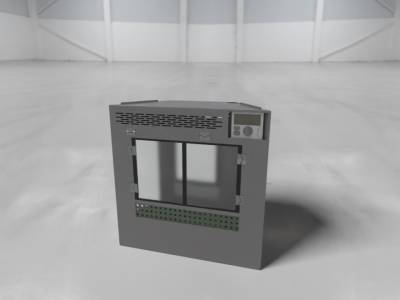
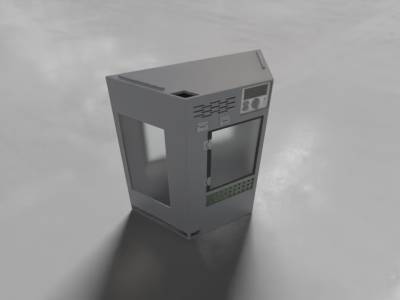
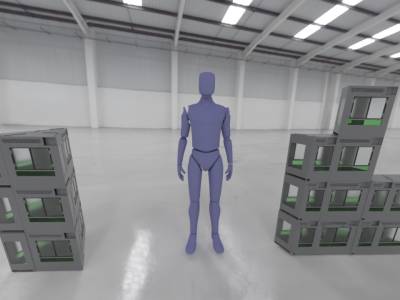
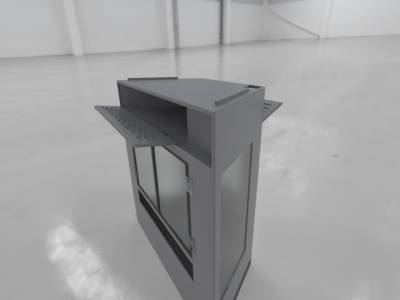
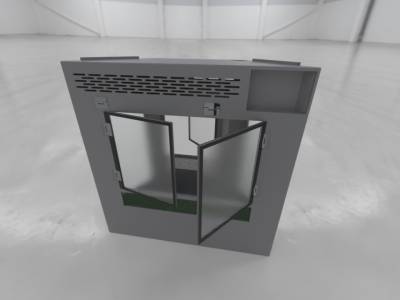
7.3.2 Cardboard Model
The cardboard model is presented in figure 25. The model is a 1:1 replica and is made of cardboard and tape. The cardboard is cut with scissors and the dimensions are taken from the CAD model.
The model is very important for the development process. This shows the dimensions clearly and allows you to quickly find errors that may not have been visible in CAD.
This model has made it clear that the doors are too big, the technical parts have too little space and many details need to be reworked. Fortunately, it is only a model and all changes can be realized quickly.
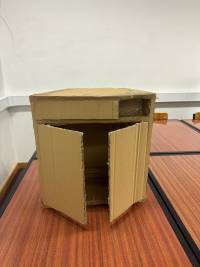
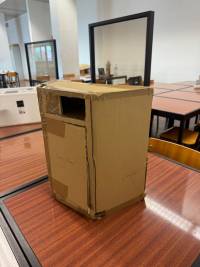
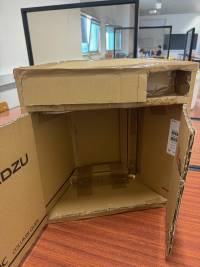
7.4 Drafts
Following the design discussion, this section emphasizes the critical role of standardized technical drawings, or “drafts.” These encompass various representations, from technical drawings to black boxes. Drafts are essential for accurate product manufacturing and adhere to international standards, ensuring global understanding and flexible production.
7.4.1 Technical Drafts
This chapter presents a collection of technical drafts, the essential blueprints for constructing the Scarabreed vivarium. These detailed, standardized drawings ensure clear communication and precise manufacturing, empowering a successful product creation process.
The assembly of the beetle breeding vivarium can be seen in Figure 26.

The drawing and the measurements of the frame for the beetle breeding vivarium can be seen in Figure 27.

The drawing and the measurements of the door frame for the vivarium can be seen in Figure 28.

7.4.2 FEM Calculation
A FEA (Finite Element Analysis) study will be performed in this chapter. Within the FEM (Finite Element Method) type of analysis, the FEA study can be found. FEM is a general method, while FEA is a specific process. FEM can be applied to any system that can be represented by finite elements, whereas FEA is dependent on the problem and the model being analysed. FEM is a theoretical concept, while FEA is a practical too. FEM provides the mathematical foundation, while FEA requires software and hardware to implement it. In this chapter, an FEA study will be performed using SolidWorks software. In the study, a mesh will be made to create a finite element model of the system. The calculations considered here examine the effect on the BB V2 at a predetermined load, considering a safety factor of 1.5. FEM stands for finite element method. A mathematical technique divides a complex system into smaller and simpler parts called finite elements. Each element has a specific shape, size, and properties. By applying equations and boundary conditions to each element, it is possible to approximate the behaviour of the whole system. FEM is useful for solving problems involving stress, heat, fluid flow, vibration, and other physical phenomena. FEA stands for finite element analysis. It is the application of FEM to a specific problem or design. FEA involves creating a finite element model of the system, choosing the appropriate material properties and loading conditions, performing the calculations, and interpreting the results. The application of FEA can assist in the optimisation of a design, the testing of its performance, and the identification of potential failures [Ajay Harish, 2024].
7.4.2.1 Adjustments
A few things needed to be adjusted/removed from the current CAD file of the BB V2. All unnecessary features such as rounding and chamfers were removed. Parts and subassemblies that do not contribute to the structural integrity of the model will also be removed. This way, there will be no unnecessary calculations that will not affect the strength calculation and will only take up time. The entire file has thus been de-featured and simplified to streamline the process of the study.
7.4.2.2 Materials and External Load
Materials
The parts of this calculation are made of varied materials (customized and from the SolidWorks Standard library). However, the materials of the parts that influence its integrity were chosen during the ‘Material Comparison’. In this chapter, the advantages and disadvantages as well as the environmental impact of all materials were compared. For the frame and the doors stainless steel was chosen. This has an impact on the yield strength of the product and the weight. For the stainless steel, the most common form was chosen, namely AISI 304. Properties for specific parts of the assembly can be seen in Figure 29, these are from the Solidworks standard library.

Load
The first test shows the integrity of the construction carrying other BB V2’s. This test is performed to simulate the mounting of four beetle breeders onto each other. The four beetle breeders mount to a height of 1.60 m. The number of breeders that are mounted in this test is four because when the breeders reach a height of 1.60 m, they are all still operable by the average man and woman. A fifth breeder would make it impossible to operate all breeders for an average woman. The test simulates the bottom BB V2, carrying three other beetle breeders.
The weight of one beetle breeder is twenty kilo (incl. all internal features, decorations and organisms) and the gravitational acceleration is 9.81 m/s². The force of gravity is perpendicular downwards. These factors determine the force on the bottom beetle breeder.
20 kg × 3 BB V2 × (9.81 m)/s² =588.6 N
The force the bottom beetle breeder needs to be able to carry is 588.6 N, see Figure 30. This force will be used in the calculations.

The fixture, see Figure 31, has been chosen at this location because the weight of the other beetle breeders will be carried mainly at these two places if they are mounted on top of each other. Furthermore, a point has been chosen to secure the BB V2 three-dimensionally as well.


7.4.2.3 Meshing
After setting all settings, the mesh still needs to be determined. A small curvature-based mesh will be used in this study, as there are fillets and other details in the product that were unable to be deleted. The mesh size chosen is a maximum of 7 mm and a minimum of 1 mm. Everything in processing is now complete and the calculations can be started.
7.4.2.4 Assessment
The first test shows the integrity of the construction carrying other BB V2’s. This test is performed to simulate the mounting of four beetle breeders onto each other. The test simulates the bottom BB V2, carrying three other beetle breeders.
The estimated weight of one beetle breeder is 20 kg as the construction already reaches the weight of 18 kg. The 20 kg estimate includes all internal features, decorations, and organisms. The gravitational acceleration is 9.81 m/s². These factors determine the force on the bottom beetle breeder.
20 kg×3 BB V2 ×(9.81 m)/s² = 588.6 N
The force the bottom beetle breeder needs to be able to carry is 588.6 N. This force will be used in the calculations.
Running the study revealed that a large displacement was causing problems. Therefore, multiple advanced modifications were performed and evaluated, see Figure 32. Multiple sets of ribs were added to the construction to enhance the sturdiness. During each test, the mesh was created the same way as before the optimizations.


7.4.2.5 Results
Von Mises stresses (N/mm²)

Maximum von mises stress = 20.79 N/mm². The maximum stress with safety factor 1.5 is:
(206.807 N/mm²)/1.5=137.871 N/mm²
The calculated stress (20.79 N/mm²) is thus not too high. There is not too much stress in the beetle breeder as seen in Figure 33.
Deformations

Maximum deformation is 0.03694 mm, see Figure 34. This deformation is acceptable and an enormous optimization due to the modifications to the structure.
Factor of Safety whole (FOS)

The minimum factor of safety here, see Figure 35, is 9.9 which is higher than the minimum value of 1.5.
The FOS will increase by, for example, changing the material by one with a higher Yield strength.
This statement is proven by the following formula:
FOS = (Yield Strength/ max permissible Von Mises)
7.4.2.6 Conclusion
During this virtual verification, it was checked whether the BB V2 would withstand a force of 588.6 N. The results showed that the device could undergo the force. However, successfully undergoing this force was possible only after adjusting materials and dimensions. The entire model except for the top of the technological compartment still looked reasonably blue and could undergo heavier loads. Overall, the FOS is still well above the minimum. For this analysis, the minimum limit of 1.5 for the FOS remained intact. Further studies can be done to discover the maximum amount of beetle breeders that can be mounted onto each other.
Electrical Schematic
Electrical schematic of proposed solution:

As seen 36 details a system designed for monitoring and control of vivarium, incorporating inputs like rotary encoders, push buttons, and temperature sensors, along with outputs like LEDs, a buzzer, an LCD, a relay-controlled load, and a fan.
7.4.3 The Black Box
To figure out what goes into and out of the product to make it function as a system, the team uses a black box systems model. The images below show the black box diagram for the finalized product 37 and a simpler one for the prototype 38.


The microcontroller serves as the center of the system. Within the system, there are two different kinds of devices: input and output. It is acknowledged that among input devices are sensors—which monitor the terrariums' habitat—and user input—which modifies the devices' settings. At the output, additional high-voltage device relays were required. The microcontroller's analog output will be used for control. Microcontrollers and high-voltage outputs will be powered by a power source.
7.4.4 Power Consumption
Power consumption is crucial in developing new electronics-oriented projects. Users must know how much power is needed to power up the device. To calculate power consumption it is sufficient to multiply max drawn current with drawn voltage. As seen in Table 15, the ESP32 is going to work in Active mode which is the most power-consuming mode. For the LCD, this is the maximum power that it can use. The sensor has in the datasheet an average power consumption when it measures one time per second. The rest of the components have it written in data sheets which are available in deliverables.
| Component | Power consumption [W] [Max] |
|---|---|
| Espressif32 (ESP32) | 0.08 |
| LCD | 1.32 |
| 4xLEDs | 0.4 |
| Humidity and temperature sensor | 0.000027 |
| Fan | 1.3 |
| Door contact | 0.66 |
| Buzzer | 0.5 |
| Total power consumption | 4.26 |
7.4.5 Software
The ESP32 chip is a powerful tool for creating Internet of Things (IoT) devices. But to make your project the best it can be, you need to pick the right “ingredients.” These include the way your devices talk to each other (communication protocol), how users interact with them (app creator), and the software you use to write the code (IDE).
Each of these choices plays a big part in your project. They affect how your devices communicate, how users control them, and how easy it is for you to write and manage the code.
IDE
IDEs provide the environment in which project is created. The choice of IDE can significantly impact the level of difficulty, offering different levels of support, tools, and features. Three commonly used IDEs for ESP32 development are the Arduino IDE, PlatformIO, and Espressif IoT Development Framework (ESP-IDF). Each IDE has its strengths and weaknesses, affecting the ease of use, advanced feature availability, and overall productivity.
| IDE Platform | Advantage | Disadvantage |
|---|---|---|
| Arduino IDE | * User friendly * Community support * Cross-Platform Compatibility | * Limited Advanced Features * Basic Code Editor * Primarily for Arduino |
| PlatformIO | * Advanced Features * Multi-Platform Support * Modern Code Editor | * Complex Setup * Heavier Resource Usage * Hard to use |
| ESP-IDF | * Optimized for ESP32 * Extensive Documentation * Powerful Tools | * Wide knowledge required * Manual Configuration * Less Beginner-Friendly |
As seen in Table 16 the Arduino IDE is great because it is easy to use, have extensive community support, and sufficient capabilities for a wide range of projects. This makes it an excellent choice for small project development. Communication protocols
Picking the right protocol impacts how efficiently and reliably your devices talk to each other and the broader system. Here, we explore three popular protocols used with ESP32:
- MQTT (Message Queuing Telemetry Transport): messaging platform where your devices can subscribe and publish information. This is ideal for scenarios where multiple devices need to share data efficiently, especially when battery life is a concern.
- HTTP (Hypertext Transfer Protocol): This is the same protocol websites use to communicate. It's fast and familiar, but might be power-hungry for battery-powered devices and might not be the best choice for a large network of devices.
- CoAP (Constrained Application Protocol): CoAP is a more streamlined version of HTTP, designed specifically for devices with limited resources. It's perfect for situations where devices need to exchange small amounts of data efficiently.
The best protocol depends on your specific project requirements. Consider factors like power consumption, scalability, and the type of data being exchanged when making your decision.
| Protocol | Advantage | Disadvantage |
|---|---|---|
| MQTT | * Low Bandwidth Usage * Lightweight and Efficient * Publish/Subscribe Model | * Broker Dependency * Security Configuration * Quality of Service Trade-offs |
| HTTP | * Ubiquitous and Well-Understood * Simple Request/Response Model * Interoperability | * High Overhead * Less Suitable for Real-Time Communication * Resource Intensive |
| CoAP | * Designed for IoT * Low Overhead * RESTful Interaction | * Less Mature Ecosystem * Limited Security Options * Niche Use Cases |
As seen in Table 17 MQTT stands out due to its efficiency, scalability, and reliability, making it an ideal choice for applications involving the ESP32. Its low resource consumption and flexible communication model suits well with the needs of simple devices and complex IoT networks.
App creators
App creators are tools that are providing us to the development of applications that interface with the ESP32, creating user-friendly interfaces for controlling and monitoring devices. The choice of app creator influences the level of difficulty of app development, the range of available features, and the overall user experience. Popular app creators for ESP32 include Node-RED, Blynk, and Thunkable, each offering unique capabilities.
| Protocol | Advantage | Disadvantage |
|---|---|---|
| Node-RED | * Visual Programming * Extensive Integration * Community and Plugins | * Initial Learning is hard * Resource Usage * QSecurity Setup |
| Blynk | * User-Friendly Interface * Pre-Built Widgets * Real-Time Monitoring | * Limited Customization * Subscription Costs * Dependency on Mobile App |
| Thunkable | * No-Code Development * Cross-Platform Apps * Community and Tutorials | * Limited IoT Integration * Complexity in Advanced Features * Subscription Model |
As seen in Table 18 Node-RED is the best choice for developing ESP32 applications due to its flexibility, powerful visual workflow management, and extensive ecosystem. These features make it a perfect choice for Scarabreed project. With this software it is easy to do from simple automation tasks to complex data processing.

As seen in Figure 39 the user can adjust the preferences in the app. To make breeding as effective as possible users can adjust settings for the best breeding conditions.
7.5 Materials
This chapter compares and describes materials. It outlines how different materials behave, what their strengths and weaknesses are and how these properties affect the design and construction of your project. Environmental compatibility is also an important point in this chapter. In the end, all points are weighed up and decisions are made.
7.5.1 Material Comparison
The advantages and disadvantages as well as the environmental impact of the current options are explained here. The aim is to simplify the selection of the material and find the best solution for the project. This is simply illustrated by the Table 19. A selection is then made and explained at the end.
| Material | Pro | Contra | Environmental |
|---|---|---|---|
| Steel | * High Strenght * Versatility * Magnetic | * Susceptibility to corrosion * Weight * Manufacturing Process | * 100% Recycalbility |
| Stainless Steel | * Corrosion Resistance * Aesthetic Appeal * Hygienic | * Expensive * Difficult Machinability | * 100% Recycalbility |
| Aluminium | * Lightweight * Corrosion Resistance * Formability | * Lower Strenghts | * 100% Recycability but high energy consumption in Production |
| Polyethylen | * Leightweight and Formale * Chemical Resistance * Flexibility | * Limited heat Resistance * Difficult production * Manufacturing Process | * Recycabel but quality degration |
| Polyvinyl chloride (PVC) | * Versatility * Durability * Cheap | * Limited heat Resistance * Difficult production | * Harmful emissions during during production * Difficult to recycle |
| Polypropylene | * Lightweight * Heat Resistance | * Tear-Sensitive * Less formable than other Plastics | * Recyclable but quality digression |
| Polyethylene Terephthalate (PET) | * Transparent * Chemical Resistance * Colourable | * Limited heat resistance * Difficult production | * Recyclable but quality digression |
| Wood | * Cheap * Simple Manufacturing Process | * No Water resistance * Lower Strengths * Manufacturing Process | * Less Energy for Production * Suport Sustainable Forest Management |
The team decides to manufacture the product from stainless steel. There are several points in favour and against. The modern look, the robustness, and the good reusability speak in favour. One of the most significant aspects of this process is the ability to produce in small quantities. The price and weight speak against it. In addition, production is more demanding, but there are now many intelligent solutions in modern industry. At a later stage, the use of high-quality and reusable plastic could be considered. Nevertheless, this would require large quantities, and the development of more environmentally friendly plastics would be necessary.
7.5.2 Hardware Comparison
To select the best hardware for electronics it is necessary to compare with other solutions. The most crucial component is the microcontroller. It is therefore essential to ensure that this core is connected to all other components.
| Microcontroller | Pro | Contra |
|---|---|---|
| Arduino Nano | * Big amount of libraries * Simplicity | * expensive |
| ESP 32 WROOM-C | * Big amount of libraries * Simplicity * Good power management * Very cheap | * Limited processing power |
| STMicroelectronics NUCLEO-L476RG STM32L476RG | * Processing power * Very adjustable for user * A lot of peripheral devices | * expensive * Complex environment |
The project is based on ESP32. As seen at 20 has the best value-to-price ratio. It has everything the beetle breeder needs. LCD Display had no comparison because the project needed I2C protocol plus a very low price. This one is the only one that has both on Mouser's page.
| Sensor | Pro | Contra |
|---|---|---|
| SHT21 | * High Accuracy * Calibration * Digital Output * Low Power Consumption | * expensive |
| DHT22 | * Decent Accuracy * 1-wire protocol * Affordable | * Slower response time * Big size * High power consumption |
| BME280 | * Additional pressure Measurement * High Accuracy * Low Power Consumption * Small size | * expensive |
SHT21 is best for applications requiring high accuracy and fast response times with moderate integration complexity. It's suitable for professional and industrial applications where precision is crucial. As seen at 21 this sensor is the most suitable for our project. The rest of the components are very basic and do not require comparison.
7.5.3 Lists of Materials for the Prototype
All products for the prototype are shown in Table 22. The budget for the prototype is 100 €. This must also include the transport costs and VAT. It is very difficult to build a reasonable prototype with this small budget. Despite the challenges, a satisfactory solution was ultimately reached.
| Component | Description | Materials | Measurements | Quantity | Company | Price [€] | Link |
|---|---|---|---|---|---|---|---|
| Window | Transparent Plate | synthetic glass plate | 500x1000x2 mm | 1 | Leroy Merlin | 13.26 | Shopping link |
| Plate | Main Material | CRU | 2440X1220X10 mm | 0.5 | Leroy Merlin | 9.20 | Shopping link |
| Hinge | for the Doors | Metal | 20×60 mm | 4 | Leroy Merlin | 5.96 | Shopping link |
| Screw | for the Hinge | Metal | M4x30 mm | 4 | Leroy Merlin | 6.29 | Shopping link |
| Screw | for the Hinge | Metal | M4x20 mm | 8 | Leroy Merlin | - | - |
| Screw | for the Hinge | Metal | M4x16 mm | 4 | Leroy Merlin | - | - |
| Washer | for the Screws | Metal | D4 mm | 4 | Leroy Merlin | 2.99 | Shopping link |
| Wood Screw | Metal | 3×20 mm | 45 | Leroy Merlin | 1.49 | Shopping link | |
| Sealing | for the Door | Plastic | 6 m | 0,5 sharing with group 3 | Leroy Merlin | 4.75 | Shopping link |
| Door Magnet | for the Door | Plastic and Metal | 15x18x45 mm | 1 | Leroy Merlin | 1.09 | Shopping link |
| Wood Glue | To connect the Wood | - | Bottle | 1 | Leroy Merlin | 3.19 | Shopping link |
| Total Price for Hardware | 48.23 € | ||||||
| Microcontroller ESP32 | Mind of all electronics, Chosen because of its low power consumption and price. | - | 55x26x13 mm | 1 | Mouser | 7.44 | Shopping link |
| LCD Display | I2C simple display | - | 80x40x13,5 mm | 1 | Mouser | 6.05 | Shopping link |
| LEDs for inside light | Amber emitter diodes for light inside Vivarium | - | 5,9x5x34 mm | 5 | Mouser | 2.95 | Shopping link |
| Door contact | It would check if the doors are closed | - | 23×13,9×5,9 mm | 1 | Mouser | 6.01 | Shopping link |
| Humidity and Temperature Sensor | This one have high accuracy and Resolution | - | 2,5×2,5×0,9 mm | 1 | Mouser | 4.59 | Shopping link |
| Breadboard | Provides connection between modules and microcontroller | - | 72x32x12 mm | 1 | Mouser | 6.97 | Shopping link |
| Jumper wires | With breadboard provides connection (male-male) | - | 20 cm | 40 | Mouser | 4.43 | Shopping link |
| Button | Part of user interface. changing menus. | - | 8,5×8,5×15,75 mm | 1 | Mouser | 0.4 | Shopping link |
| Power Supply | Provides power for system | - | 3.5×1.3 mm | 1 | Mouser | 3.8 | Shopping link |
| Power Connector | Provides connection to power | - | 3.5×1.3 mm | 1 | Mouser | 1.2 | Shopping link |
| Fan | 5V DC Fan for ventilation | - | 50x50x12 mm | 1 | Mouser | 4.89 | Shopping link |
| MOSFET | Using IRFZ44NPBF as level shifter for PWM regulation for fan | - | 10,7×25,4×4,8 mm | 1 | Mouser | 0.88 | Shopping link |
| Resistors | 1k Ohm resistors | - | 1 | Own supply | 0.22 | ||
| Buzzer | Notification indicator | - | - | 1 | Mouser | 0.7 | Shopping link |
| Total Price for Electronics | 50.47 € | ||||||
| Total Price for Hardware | 98.7 € |
7.6 Packaging
Scarabreed's packaging solution is designed with sustainability in mind, aiming to minimize waste and environmental impact. The packaging consists of three main parts: the box lid, the box fitment, and the bottom of the box. Each component is crafted from 3 mm thick recycled cardboard, reducing the need for new raw materials and promoting a circular economy.
7.6.1 3D Packaging
For the packaging design, Scarabreed opted to preserve the natural craft of the cardboard, enhancing it with key elements such as the logo, the product name, essential information, a QR code linking to the website, and some images showcasing the modular vivarium designs, see Figure 40. Templates inside of our packaging are also provided for users to cut out and repurpose the packaging for future use, see Figure 40.

The 3D representation of the packaging illustrates the assembly process. The vivarium will be contained in the bottom of the box, supported by two box fitments, one on the top and one on the bottom of the vivarium, ensuring stability and preventing breakage. Once all pieces are assembled, the box lid completes the packaging.
7.6.2 The packaging development
The team initiated the design process by sketching out concepts on paper and exploring various ideas and configurations, see Figure 41.

Once a concept was selected, the team developed a paper 3D prototype, in good proportion. Each part was crafted and assembled to ensure compatibility and functionality. By physically assembling and testing the paper models, the team gained valuable insights into the structural integrity and functionality of the design.
This hands-on approach enabled the company to identify any potential issues or improvements early in the design process, ensuring that the final packaging would meet quality and performance.
Then the creation of the templates on BricsCAD starts. The packaging team creates scale templates with cutting and folding lines and quotations. BricsCAD [BricSys, 2024] is a powerful CAD software platform that offers a wide range of tools for creating 2D designs.
Moreover, the design of the packaging was planned to be adaptable to a mechanical development chain in order to be easily included in the production process.
7.6.3 The box lid
The box lid serves as the primary cover for the vivarium packaging. It is designed to be sturdy yet lightweight, protecting the contents while minimizing material usage. Additionally, the design of the tabs with the ears allows great fixation so that the box lid does not open during transportation without the need for glue or scotch. By folding the ears and then removing the tabs from the hole, the user can easily have the packaging’s template without breaking the box lid which would ease the reusability of the packaging, see Figures 42 and 43.


7.6.4 The bottom of the box
The bottom of the box completes Scarabreed's eco-responsible packaging solution. Made from recycled cardboard, it provides a stable base for the vivarium while further minimizing environmental impact. The bottom section is designed to accommodate the assembled fitment ensuring durability and longevity, supporting Scarabreed's commitment to sustainability and conservation, see figures 44 and 45.


7.6.5 The box fitment
The box fitment safeguards the vivarium from impacts within the packaging, ensuring it arrives intact and unharmed. It is engineered to be assembled without the use of glue. There are two box fitments. One goes above the vivarium for extra protection, while the other sits below, providing structural support. Like the rest of the packaging, the fitment is constructed from recycled cardboard, see figures 46 and 47.


7.6.6 Interlocking tabs
The bottom and lid of the packaging can be securely linked using interlocking tabs. This feature not only simplifies assembly for the user but also reinforces the eco-friendly nature of the packaging by eliminating the need for additional adhesives or glues. By incorporating interlocking tabs into the design, Scarabreed demonstrates its commitment to innovation and sustainability in packaging solutions. This user-friendly feature enhances the overall experience of assembling and using the vivarium, reinforcing Scarabreed's reputation as a brand that prioritizes both functionality and environmental responsibility, see figure 48.

7.6.7 Reusability
The lid features templates that allow it to be easily transformed into seven small boxes. These smaller compartments offer users a convenient way to organize and store beetle breeding essentials without the need for glue or additional assembly. The boxes can be stored inside the bottom section for convenient storage, see figures 49, 50 and 51.


7.6.8 Sustainability features
Throughout the packaging design process, Scarabreed prioritizes sustainability by incorporating several key features:
- Recycled Cardboard: All components of the packaging are crafted from recycled cardboard, reducing the demand for virgin materials and diverting waste from landfills.
- Minimal Ink Usage: The packaging design minimizes the use of ink, opting for simple, eco-friendly printing techniques that prioritize resource efficiency.
- Glue-Free Assembly: Scarabreed's packaging is engineered to be assembled without the need for glue or adhesives, eliminating potentially harmful chemicals and making recycling easier.
- Modular Design: The packaging's modular design not only enhances user convenience but also promotes resource efficiency by allowing components to be reused or repurposed.
By embracing these sustainability principles, Scarabreed sets a new standard for eco-responsible packaging in the vivarium industry, demonstrating a commitment to conservation and environmental stewardship.
7.7 Prototype
This chapter describes the prototype built for this project. Although considerable changes had to be made to the original design due to budget restrictions, it was possible to build a true-to-scale (1:1) replica. Points 7.7.1 and 7.7.2 deal with the hardware modifications. The software customizations are also explained, including the code developed for the smart device, which is illustrated with clear code flow diagrams (section 7.7.3). The chapter concludes with an examination of the prototype's performance through the hardware and software testing procedures described in Section 1.6 (Section 7.7.4). These tests use a combination of tables and established metrics to evaluate functionality, performance and usability.
7.7.1 Structure
The prototype's structure is a fine example of how to effectively integrate technical principles and budgetary limitations. Originally envisioned with stainless steel and complex windows, the design pivoted to wood, a more cost-effective material, as the primary structure. Despite this shift, the prototype remains a true-to-scale (1:1) replica, preserving the intended aesthetic.
However, budgetary constraints limited the number of functioning doors. While high-quality hinges were ideal, their expense necessitated a single operational door. This door, however, has an exceptional seal, ensuring a gap-free environment suitable for beetle habitation and full functionality testing.
The project's greatest challenge lay in realizing the desired design with a strict €100 budget. Due to this limitation, wood—a thicker but still far less expensive option than the thin metal that was initially intended—had to be creatively used. While the wood offers a different aesthetic, it successfully fulfills all structural requirements, showcasing the project's ability to adapt and creative application of technical solutions.
7.7.2 Prototype construction
Planning and cutting
In order to waste as little material as possible, the cutting of the parts was carefully planned. The parts were cut using a table saw and then milled at a 30-degree angle using a milling machine. The windows and doors were cut out with a jigsaw. This is seen in Figure 52.


Gluing, glazing and panelling
The parts were then glued and screwed together. The windows were glued in with hot glue and the door is made of double glazing to fulfil the sealing requirements. The assembly of the components can be seen in Figure 53.


Electronics and fine tuning
Finally, the electronic components were fitted, the technical department installed and the door adjusted. This is shown in Figure 54.


Construction time
It took more than 4 days to build the prototype.
7.7.3 Software
The software was developed with each component in mind and then integrated into a single code. The door contact was experiencing intermittent issues due to a lack of a pull-up resistor. Once this was rectified, the system was fully operational. One button is used to change the menu, while the other is a trigger for each functionality. The fan is functioning in conjunction with the LED stripe. When the fan is activated, the LED stripe turns blue, indicating that the status has been updated on the display. The door contact is integrated with the display and LED stripe. Upon opening the doors, the LED stripe is activated, updating the display in real-time.
This is different from the designed solution. The flashing LED stripe and changing the color when the fan is ON would not apply to the designed solution.
Code


As seen in Figure 55 the libraries and enum type for the menu list are created. In this fragment also all definitions are defined. As seen in Figure 56 I2C is created and all inputs and outputs are declared. In Figure 57 the menu switching is declared and implemented. Plus there is logic for door contact. In Figure 58 The toggle button is declared and all logic for presentation code is implemented. In Figure 59 all the data is displayed on OLED. As seen in Figure 60 declaration of the wifi setup function. Figure 61 shows how sending data to the mosquito is implemented.
Data chart

As seen in Figure 62 monitoring app is sending the data to MQTT broker.
7.7.4 Tests & Results
In this Subchapter, all changes and progress with the prototype are analyzed. Tables with Tests and results plus the difference to the final solution.
Hardware tests

Figure 63 illustrates the use of two power supplies for the prototype. The 5 V power supply is designated for the ESP32 and fan, while the 12 V supply is allocated for the LED stripe. The implementation of a voltage regulator could facilitate the reduction of the 12V supply to 5 V. The fan control system employs a straightforward Darlington bridge configuration comprising two transistors. In consideration of the limited budgetary constraints, the infrared light, humidity spray, and buzzer were excluded from the final design. The remaining components are identical to those employed in the deliverable solution.
| Component | Power consumption [Max] |
|---|---|
| Power supply supplies 5V | Pass |
| Temperature and humidity sensor gives correct values | Pass |
| Door contact is responsive | Pass |
| OLED is programmable | Pass |
| Fan connection is correct | Pass |
| Fan is programmable (ON/OFF) | Pass |
| LED stripe is working | Pass |
Every connection was tested with a multimeter.
Software tests
The software was tested with every component and then it was implemented in one source file. The door contact was malfunctioning for most of the time because of the lack of a pull-up resistor then it worked fine. One button is responsible for changing the menu and the other like a trigger for each functionality.

Table 64 holds the functional and performance results of the implemented back-end Application Programming Interface (API). The data exchanged plus the average μ and standard deviation σ latency values were obtained by repeating each request ten times.

Table 65 displays the load results for the longest API request. These results show that, when in production, the Web app must be hosted by an elastic server solution to reduce the latency to values compatible with an acceptable user experience. As expected, the exchanged data per request remains unchanged.
7.8 Conclusion
After analyzing existing brands and technologies, Scarabreed has successfully developed the BBV2 - Beetles Breeder Version 2, a solution for breeding endangered beetle species.
The BBV2 features a modular design, allowing for easy scaling, customization, and transport. It has a trapezium form optimized for stability and space efficiency, and it provides dual access from both the front and back for convenient maintenance and monitoring. The technological compartment at the top monitors and controls environmental parameters. Built-in cable ducts enable seamless connection and scalability of multiple vivariums. The BBV2 is constructed from high-quality stainless steel for durability. The team uses an ESP32 microcontroller and an SHT21 sensor for precise humidity and temperature control.
Technically, the team conducted Finite Element Analysis (FEA) to approximate system behavior and validated structural integrity through load testing, confirming the system withstands 588.6 N which was ensured by structural reliability with mesh analysis. For the realization of the vivarium, CAD models were made using SolidWorks, followed by a cardboard prototype to identify and correct potential issues. Additionally, lists of materials were made for both the prototype and the final product. The team also designed a reusable and sustainable packaging to minimize environmental impact.
The company has completed the technical drafts, electrical schematics, black box designs, power consumption analysis, and user interface software for the BBV2. The realization of the prototype marks the culmination of the development process.
8. Conclusions
In this chapter, the conclusion is presented in two parts: the discussion and future development. The discussion covers the achievements and what could have been improved during this semester. The future development section offers recommendations for future work.
8.1 Discussion
As outlined in Chapter 1.4, the primary objective of Scarabreed is to develop a beetle breeding device that will enhance ecosystem resilience by increasing biodiversity. Another objective is to raise awareness about this topic. The report addresses both of these objectives and outlines a plan for achieving them. The objective outcomes are discussed below:
- Beetle Breeding Device:
To create an effective beetle breeding device, Scarabreed has identified the optimal conditions for beetle reproduction. To guarantee these conditions, the company has developed a product with electronic features, including humidity, temperature, and light regulation. With these features, Scarabreed has secured a strategic market position, as other companies do not supply vivariums with electronics. Earlier in this semester, the beetles were received from the teachers and the team bred some beetles in a plastic vivarium, which proved to be a success. However, endangered insects often have difficulties with breeding. So, with this knowledge and the electrical features, Scarabreed can confirm that it is possible to use the BBV2 to breed more species of beetles.
- Spreading awareness: In the marketing chapter, the approach to spreading awareness is discussed. This is a vital part for Scarabreed as it is important to restore ecosystems and preserve them. Without this, global warming will be more severe and the consequences will be catastrophic. To spread awareness, the team will partner with schools to teach students about the necessity of preservation. Furthermore, online marketing will be used to show how to optimise the breeding process and it will be used inform people about the importance of the restoration of ecosystems. This will go hand in hand with product marketing.
The plans for the two main objectives have been discussed. These are expected to be successful. Scarabreed believes in the people to help with the preservation of ecosystems. With working together, a big difference can be made.
8.2 Future Development
The recommendations for future work will be described below. The main thought is that if this project would see a sequel, this is what Team Scarabreed would recommend.
Some recommendations are:
- Greater budget:
If Team Scarabreed had a larger budget, the possibilities for building the prototype would have been greater. Furthermore, if the budget had been more substantial, more functional tests could have been conducted to assess the product more thoroughly.
- Direct engagement with local nature organisations:
By establishing direct communication with organisations such as WWF and The Nature Conservancy, the possibility of properly testing the BBV2 is increased. As the product can be used in multiple different projects, this is an important consideration. Furthermore, the launch of this product will result in significant early sales, which will contribute to the financial stability of Scarabreed. The communication with nature organisations will also provide valuable insights into specific beetle species, which will enhance the effectiveness of the beetle breeder.
